Bluetooth Low Energy Fundamentals

Changing the version will not affect your certificate
Lesson 1 –  Bluetooth LE Introduction
5 Topics | 1 Quiz
What is Bluetooth LE?
GAP: Device roles and topologies
ATT & GATT: Data representation and exchange
PHY: Radio modes
Exercise 1 – Testing a Bluetooth LE connection
Lesson 1 quiz
Lesson 2 – Bluetooth LE Advertising
7 Topics | 1 Quiz
Advertising process
Advertising types
Bluetooth address
Advertisement packet
Exercise 1 – Setting the advertising data
Exercise 2 – Advertising Manufacturer Specific Data
Exercise 3 – Connectable advertising and address configuration
Lesson 2 quiz
Lesson 3 – Bluetooth LE Connections
4 Topics | 1 Quiz
Connection process
Connection parameters
Exercise 1 – Connecting to your smartphone
Exercise 2 – Updating the connection parameters
Lesson 3 quiz
Lesson 4 – Data exchange in Bluetooth LE
6 Topics | 1 Quiz
GATT operations
Services and characteristics
Attribute table
Exercise 1 – Creating a custom service and characteristics
Exercise 2 – Adding notification and indication support
Exercise 3 – Sending data between a UART and a Bluetooth LE connection
Lesson 4 quiz
Lesson 5 – Security in Bluetooth LE communication
5 Topics | 1 Quiz
Pairing process
Legacy pairing vs LE Secure Connections
Security modes
Exercise 1 – Add pairing support to a Bluetooth LE application
Exercise 2 – Implement bonding and a Filter Accept List
Lesson 5 quiz
Lesson 6 – Bluetooth LE sniffer
5 Topics | 1 Quiz
Sniffing Bluetooth LE packets
Setting up nRF Sniffer for Bluetooth LE
Exercise 1 – Capture and analyze Bluetooth advertising packets
Exercise 2 – Inspect a Bluetooth connection, analyze GAP and GATT packets
Exercise 3 – Follow and decrypt a paired connection
Lesson 6 quiz
Get your Certificate!
Feedback
Feedback

If you are having issues with the exercises, please create a ticket on DevZone: devzone.nordicsemi.com
Drag & Drop Files, Choose Files to Upload You can upload up to 2 files.
Loading
RegisterLog in

What is Bluetooth LE?

Navigation

If you prefer browsing content in dark mode, check out this page: Dark mode: Yes, please!

Bluetooth Classic is the version of Bluetooth you have most likely used before due to its prevalence in common items such as wireless headsets. It is quite evident that Bluetooth is a perfect fit for applications such as streaming music. The data throughput is high enough to support it without connection problems or packet loss, plus it’s very easy to use. You probably need to recharge your smartphone and your wireless speakers after some time, but that is not a problem in this kind of application.

However, for low-power wearables or massive IoT applications, frequent battery charging is not feasible, especially when such high data transfer speeds are not necessary. Therefore, starting from Bluetooth Core Specification version 4.0, the Bluetooth SIG (Special Interest Group) introduced Bluetooth Low Energy (LE), with the intention of making it a key enabler for low-power IoT applications.

Bluetooth LE features

Bluetooth LE, as its name implies, focuses on achieving low energy consumption by sacrificing data rate. Sacrificing data rate refers to two mechanisms here. Firstly, data packets are made smaller, ranging from 27 to 251 bytes. Secondly, data is being sent as seldom as possible to avoid long radio-on times, which is a significant factor in power consumption. This makes Bluetooth LE more suitable for battery-operated devices that need to operate on minimal power and only send small bursts of data.

Bluetooth LE differs from Bluetooth Classic in other aspects as well, such as supported topologies and node types. This is because Bluetooth LE was intended for completely different use cases than Bluetooth classic, therefore different network topologies were necessary.

The table below summarizes some of the key aspects of Bluetooth LE.

Operating band2400 MHz – 2483.5 MHz
~ 2.4 GHz
Channel bandwidth2 MHz
Number of RF channels40
Maximum transmit power20 dBm
0.1 W
Maximum application data throughput1.4 Mbps
Maximum range at reduced data rates (125 & 500 kbps)~1000 m
Summary of Bluetooth LE specification

Note

Range will always depend on a number of factors related to the software and hardware configuration of the devices used, as well as the specific environment where the devices operate. Therefore, it is very difficult to have a generalized precise range estimate.

However, an online range estimator like the one here https://www.bluetooth.com/learn-about-bluetooth/key-attributes/range/ could give an acceptable estimate of what range to expect out of your Bluetooth LE devices, given the configuration indicated in the guide calculator.

A key advantage of Bluetooth Low Energy is its low cost when compared to other low-power personal area networks, making it attractive for applications requiring mass deployments.

The technology is also prevalent in smartphones (most smartphones support both Bluetooth Classic and Bluetooth LE), making it easy to test and prototype applications everywhere. In addition to the smartphone, one more Bluetooth LE device is needed to be able to test two-way communication. Since practically everyone has a smartphone, this reduces the cost and complexity required to conduct tests compared to other technologies where specific hardware is needed.

With Nordic Semiconductor’s wide variety of Bluetooth LE offerings, you will also get implementation flexibility, open-source documentation and continuous customer support. You can read more about Nordic Semiconductor’s Bluetooth LE offerings on our website.

Bluetooth LE protocol stack

A deep understanding of all the individual layers of the protocol stack is not an absolute necessity for enabling and using Bluetooth LE in your application. Nonetheless, understanding the basics of the different layers and some of their main functions does help with having an overview of what’s happening under the hood with the Bluetooth LE stack. This is what we will cover in next section.

Certain layers, due to their importance, will be further explained in subsequent lessons.

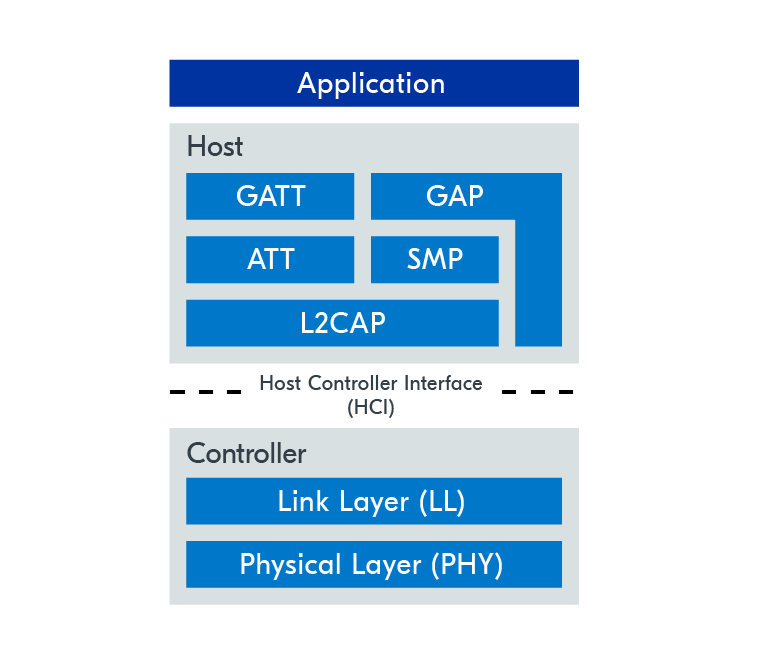
The image below depicts the protocol stack architecture, showing which layers make up the Bluetooth LE host and which make up the Bluetooth LE controller.

At the top, you have the application. This is the layer that the user interacts with, through API’s, to make use of the Bluetooth LE protocol. Important parts of the application layer include profiles, services, and characteristics, which will be explained more thoroughly in the upcoming lessons. The next layers make up the host, which essentially determines how Bluetooth LE devices store and exchange data between each other. Lastly, the controller makes up the lower layers, with the most notable part being the physical radio which generates the radio waves and encodes the signals with the data you want to send.

Host

The Bluetooth LE host consists of the following layers:

  • Logical Link Control & Adaptation Protocol (L2CAP): provides data encapsulation services to the upper layers.
  • Security Manager Protocol (SMP): defines and provides methods for secure communication.
  • Attribute Protocol (ATT): allows a device to expose certain pieces of data to another device.
  • Generic Attribute Profile (GATT): defines the necessary sub-procedures for using the ATT layer.
  • Generic Access Profile (GAP): interfaces directly with the application to handle device discovery and connection-related services.

The Zephyr Bluetooth Host implements all these layers and provides an API for applications.

Controller

The Bluetooth LE controller is comprised of the following layers:

  • Physical Layer (PHY): determines how the actual data is modulated onto the radio waves, and how it is transmitted and received.
  • Link Layer (LL): manages the state of the radio, defined as one of the following – standby, advertising, scanning, initiating, connection.

The Bluetooth LE controller implementation we will be using in this course is the SoftDevice Controller, found in the nRF Connect SDK. Both the SoftDevice Controller and the Zephyr Bluetooth Host form the full Bluetooth LE protocol stack that is available in the nRF Connect SDK.

Important

The nRF Connect SDK contains an alternative controller implementation, the Zephyr Bluetooth LE Controller. However, we strongly recommend using the SoftDevice Controller, as it is specifically designed for the nRF52, nRF53 and nRF54 Series devices.

Make sure to Log in or Register to save your progress

Back
Next

Nordic Developer Academy Privacy Policy


1. Introduction 

In this Privacy Policy you will find information on Nordic Semiconductor ASA (“Nordic Semiconductor”) processes your personal data when you use the Nordic Developer Academy.

References to “we” and “us” in this document refers to Nordic Semiconductor.


2. Our processing of personal data when you use the Nordic Developer Academy 

2.1 Nordic Developer Academy 

Nordic Semiconductor processes personal data in order to provide you with the features and functionality of the Nordic Developer Academy. Creating a user account is optional, but required if you want to track you progress and view your completed courses and obtained certificates. If you choose to create a user account, we will process the following categories of personal data:

  • Email
  • Name
  • Password (encrypted)
  • Course progression (e.g. which course you have completely or partly completed)
  • Certificate information, which consists of name of completed course and the validity of the certificate
  • Course results

During your use of the Nordic Developer Academy, you may also be asked if you want to provide feedback. If you choose to respond to any such surveys, we will also process the personal data in your responses in that survey.

The legal basis for this processing is GDPR article 6 (1) b. The processing is necessary for Nordic Semiconductor to provide the Nordic Developer Academy under the Terms of Service.


2.2 Analytics 

If you consent to analytics, Nordic Semiconductor will use Google Analytics to obtain statistics about how the Nordic Developer Academy is used. This includes collecting information on for example what pages are viewed, the duration of the visit, the way in which the pages are maneuvered, what links are clicked, technical information about your equipment. The information is used to learn how Nordic Developer Academy is used and how the user experience can be further developed.


2.2 Newsletter 

You can consent to receive newsletters from Nordic from within the Nordic Developer Academy. How your personal data is processed when you sign up for our newsletters is described in the Nordic Semiconductor Privacy Policy.


3. Retention period 

We will store your personal data for as long you use the Nordic Developer Academy. If our systems register that you have not used your account for 36 months, your account will be deleted.


4. Additional information 

Additional information on how we process personal data can be found in the Nordic Semiconductor Privacy Policy and Cookie Policy.

‍‍ 

Nordic Developer Academy Terms of Service


1. Introduction

‍These terms and conditions (“Terms of Use”) apply to the use of the Nordic Developer Academy, provided by Nordic Semiconductor ASA, org. nr. 966 011 726, a public limited liability company registered in Norway (“Nordic Semiconductor”). ‍

Nordic Developer Academy allows the user to take technical courses related to Nordic Semiconductor products, software and services, and obtain a certificate certifying completion of these courses. By completing the registration process for the Nordic Developer Academy, you are agreeing to be bound by these Terms of Use.

These Terms of Use are applicable as long as you have a user account giving you access to Nordic Developer Academy.‍

‍2. Access to and use of Nordic Developer Academy

‍‍Upon acceptance of these Terms of Use you are granted a non-exclusive right of access to, and use of Nordic Developer Academy, as it is provided to you at any time. Nordic Semiconductor provides Nordic Developer Academy to you free of charge, subject to the provisions of these Terms of Use and the Nordic Developer Academy Privacy Policy.

To access select features of Nordic Developer Academy, you need to create a user account. You are solely responsible for the security associated with your user account, including always keeping your login details safe.

You will able to receive an electronic certificate from Nordic Developer Academy upon completion of courses. By issuing you such a certificate, Nordic Semiconductor certifies that you have completed the applicable course, but does not provide any further warrants or endorsements for any particular skills or professional qualifications.

Nordic Semiconductor will continuously develop Nordic Developer Academy with new features and functionality, but reserves the right to remove or alter any existing functions without notice.

‍3. Acceptable use

You undertake that you will use Nordic Developer Academy in accordance with applicable law and regulations, and in accordance with these Terms of Use.‍ You must not modify, adapt, or hack Nordic Developer Academy or modify another website so as to falsely imply that it is associated with Nordic Developer Academy, Nordic Semiconductor, or any other Nordic Semiconductor product, software or service.

You agree not to reproduce, duplicate, copy, sell, resell or in any other way exploit any portion of Nordic Developer Academy, use of Nordic Developer Academy, or access to Nordic Developer Academy without the express written permission by Nordic Semiconductor. You must not upload, post, host, or transmit unsolicited email, SMS, or \”spam\” messages.

You are responsible for ensuring that the information you post and the content you share does not;

  • contain false, misleading or otherwise erroneous information
  • infringe someone else’s copyrights or other intellectual property rights
  • contain sensitive personal data or
  • contain information that might be received as offensive or insulting.
  • Such information may be removed without prior notice.

‍Nordic Semiconductor reserves the right to at any time determine whether a use of Nordic Developer Academy is in violation of its requirements for acceptable use.

Violation of the at any time applicable requirements for acceptable use may result in termination of your account. We will take reasonable steps to notify you and state the reason for termination in such cases.

‍4. Routines for planned maintenance

‍Certain types of maintenance may imply a stop or reduction in availability of Nordic Developer Academy. Nordic Semiconductor does not warrant any level of service availability but will provide its best effort to limit the impact of any planned maintenance on the availability of Nordic Developer Academy.

5. Intellectual property rights

‍Nordic Semiconductor retains all rights to all elements of Nordic Developer Academy. This includes, but is not limited to, the concept, design, trademarks, know-how, trade secrets, copyrights and all other intellectual property rights.

Nordic Semiconductor receives all rights to all content uploaded or created in Nordic Developer Academy. You do not receive any license or usage rights to Nordic Developer Academy beyond what is explicitly stated in this Agreement.

‍6. Liability and damages

‍Nothing within these Terms of Use is intended to limit your statutory data privacy rights as a data subject, as described in the Nordic Developer Academy Privacy Policy. ‍You acknowledge that errors might occur from time to time and waive any right to claim for compensation as a result of errors in Nordic Developer Academy. When an error occurs, you shall notify Nordic Semiconductor of the error and provide a description of the error situation.

You agree to indemnify Nordic Semiconductor for any loss, including indirect loss, arising out of or in connection with your use of Nordic Developer Academy or violations of these Terms of Use. ‍Nordic Semiconductor shall not be held liable for, and does not warrant that (i) Nordic Developer Academy will meet your specific requirements, (ii) Nordic Developer Academy will be uninterrupted, timely, secure, or error-free, (iii) the results that may be obtained from the use of Nordic Developer Academy will be accurate or reliable, (iv) the quality of any products, services, information, or other material purchased or obtained by you through Nordic Developer Academy will meet your expectations, or that (v) any errors in Nordic Developer Academy will be corrected.

You accept that this is a service provided to you without any payment and hence you accept that Nordic Semiconductor will not be held responsible, or liable, for any breaches of these Terms of Use or any loss connected to your use of Nordic Developer Academy. Unless otherwise follows from mandatory law, Nordic Semiconductor will not accept any such responsibility or liability.

‍7. Change of terms

‍Nordic Semiconductor may update and change the Terms of Use from time to time. Nordic Semiconductor will seek to notify you about significant changes before such changes come into force and give you a possibility to evaluate the effects of proposed changes. Continued use of Nordic Developer Academy after any such changes shall constitute your acceptance of such changes. You can review the current version of the Terms of Use at any time at https://academy.nordicsemi.com/terms-of-service/

‍8. Transfer of rights

‍Nordic Semiconductor is entitled to transfer its rights and obligation pursuant to these Terms of Use to a third party as part of a merger or acquisition process, or as a result of other organizational changes.

‍9. Third Party Services

‍‍To the extent Nordic Developer Academy facilitates access to services provided by a third party, you agree to comply with the terms governing such third party services. Nordic Semiconductor shall not be held liable for any errors, omissions, inaccuracies, etc. related to such third party services.

‍10. Dispute resolution

‍‍The Terms of Use and any other legally binding agreement between yourself and Nordic Semiconductor shall be subject to Norwegian law and Norwegian courts’ exclusive jurisdiction.

 

Switch language?

Progress is tracked separately for each language. Switching will continue from your progress in that language or start fresh if you haven't begun.

Your current progress is saved, and you can switch back anytime.

Log in
Don’t have an account? Register an account

Forgot your password?
Register an account
Already have an account? Log in
(All fields are required unless specified optional)

  • 8 or more characters
  • Upper and lower case letters
  • At least one number or special character

Forgot your password?
Enter the email associated with your account, and we will send you a link to reset your password.

Back to Log in

Insert/edit link

Enter the destination URL

Or link to existing content

    No search term specified. Showing recent items. Search or use up and down arrow keys to select an item.

      Change summary

      What's new in the latest version

      General updates

      General updates

      •Support for nRF54LS05 DK (Available through the early access sampling program)
      •Support for the nRF54LM20B with Axon NPU for Edge AI applications
      Bluetooth LE updates

      Bluetooth LE updates

      •Quality of Service module is now production-ready.
      •New experimental features for RF testing (Direct Test Mode) and low-latency packet handling (LE Flushable ACL).
      MCUboot & Partition Manager

      MCUboot & Partition Manager

      •Single-Slot DFU and RAM Load mode are both promoted to fully supported
      •Partition Manager is officially deprecated in favor of Zephyr's devicetree-based partitioning.