Exercise 1 – Running and controlling a Matter device
In this exercise, you will be running the Matter light bulb sample in the nRF Connect SDK and testing it with a developer Matter controller, using the CHIP Tool.
Note
In this exercise, only the basic Matter light bulb sample usage is presented. If you want to learn more about different configurations of this sample, visit its documentation page.
After Lesson 1, you know that a Matter controller is a device in the Matter infrastructure that is used by the end user to control Matter accessories. The on-market devices capable of serving as Matter controllers are usually smartphones or smart hubs, for practical reasons. However, these devices use officially released, certified Matter software, while developers often want to develop new functionality that cannot be tested on on-market devices. It is also much more convenient for the developers to work with tools available on their PCs.
You will be using the CHIP Tool for this purpose. The CHIP Tool is a default implementation of the Matter controller role widely used by Matter developers to test their applications before releasing on-market products based on them. It is also recommended for development with the nRF Connect SDK platform.
It is not possible to communicate directly with Matter over Thread devices using the CHIP Tool, as the PC running this Matter controller does not support the Thread protocol. Therefore, an additional Thread Border Router device is required to translate the communication between those devices.
The Matter controller and Thread Border Router host application can be run on a PC, however the PC does not have an in-built radio transceiver to communicate over the Thread protocol. For this reason, it requires an external radio co-processor (RCP) device connected over USB to communicate with Thread devices. In this exercise, you will be using a second Nordic DK for this purpose.
The following image presents the described setup:
It is possible to communicate directly with Matter over Wi-Fi devices using the CHIP Tool, as the PC running the Matter controller supports the Wi-Fi protocol.
1.1 In Visual Studio Code, in the WELCOME panel, select “Browse samples”, select your SDK version, and search for “Matter Light ”.
Select the sample, and it will appear under the APPLICATIONS panel.
1.2 Add a build configuration
1.3 Select the board target corresponding to the DK you are using
nRF54L15 DK
nrf54l15dk/nrf54l15/cpuapp
nRF54LM20 DK
nrf54lm20dk/nrf54lm20a/cpuapp
Click the Generate and Build button at the bottom to build the sample
Once the building process ends, the build directory will appear in the APPLICATIONS panel.
1.4 Connect your nRF54L Series DK to the PC using a USB-C cable. Make sure that the POWER switch is in the ON position. As a result, the device should appear in the CONNECTED DEVICES panel.
1.5 Flash the application to the board using the Flash button in the ACTIONS panel. Make sure to use Erase and Flash to Board icon on the right side.
Once programming is completed, observe the LEDs on the board. LED0 on the board will blink, indicating the application is running, but the device is not connected to the network. LED1 represents the state of the light bulb and should be turned on.
Note
If you have an nRF54LM20 DK revision <0.5.0, you will need to go to the Board Configurator application in nRF Connect for Desktop and set VDD_NRF and VDDIO to less than 2.7 V. LEDs on the DK stop functioning if the value for VDD_NRF and VDDIO is set to more than 2.7 V.
1.6 Open the serial port of the board, using a VCOM in the CONNECTED DEVICES panel. Click on the Connect to Serial Port icon to the right of the VCOM.
If you do not see any logs from the device, click the RESET button on the nRF54L Series DK.
Note
The nRF54L Series DKs enumerate with two serial ports and their numbers can be different on your PC. Select the VCOM with the greater number, for example, if VCOM0 and VCOM1 are available, use VCOM1.
Logs similar to the following ones should be visible in the Terminal window:
The Matter door light bulb device is ready for further actions, but before connecting it to the network, the rest of the devices need to be set up.
2. Setting up the Thread Border Router
For development purposes, you can run the OpenThread Border Router in a Docker container on any Linux-based system, without needing to build the application manually.
To provide a way to connect to the Thread devices from your PC, the OpenThread Border Router requires a Thread radio co-processor. This can be created using a Nordic Development Kit and the Thread Coprocessor sample from nRF Connect SDK.
2.1 In Visual Studio Code, in the WELCOME panel, select “Browse samples” and search for “OpenThread Coprocessor”.
Note
You will find two OpenThread Co-Processor samples. One of them is located in the nrf directory, while the other one is located in zephyr directory. The sample located in nrf is maintained by Nordic and recommended to use, while the quality of the sample from zephyr is not verified by Nordic.
Select the OpenThread Co-processor sample from nrf, and it will appear under the APPLICATIONS panel.
2.2 Add a build configuration
2.3 Select the board target corresponding to the DK you are using for the
nRF54L15 DK
nrf54l15dk/nrf54l15/cpuapp
nRF54LM20 DK
nrf54lm20dk/nrf54lm20a/cpuapp
nRF52840 dongle
nrf52840dongle/nrf52840
nRF52840 DK
nrf52840dk/nrf52840
nRF52833 DK
nrf52833dk/nrf52833
Click the Generate and Build button at the bottom to build the sample.
Once the building process ends, the build directory will appear in the APPLICATIONS panel.
2.4 Connect your DK to the PC. Make sure that POWER switch is in the ON position. In the case of the dongle, plug it directly into the USB port on your computer
The device will appear in the CONNECTED DEVICES panel.
Switchable tabs: DK
2.5 Flash the application to the board using the Flash button in the ACTIONS panel. Make sure to use Erase and Flash to Board icon on the right side.
Switchable tabs: dongle
2.5 Flash the application the dongle.
The nRF52840 Dongle, unlike the development kits, does not have a debugger on board. Therefore, the procedure for flashing firmware is different.
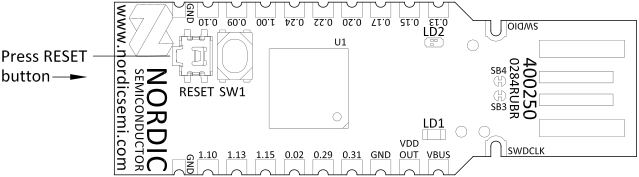
2.5.1 Put the dongle in DFU mode by simply pressing the RESET button, which is on the far side of the board from the USB connector. The button does not face up. You will have to push it from the outside in, towards the USB connector.
The RGB light will turn red with a fade pattern, signaling that the dongle is in DFU mode.
2.5.2 Generate the firmware package that is compatible with Nordic’s bootloader by typing the following command in your terminal.
Navigate to the /build/coprocessor/zephyr directory of the Radio Coprocessor sample (<ncs_install_path>/nrf/samples/openthread/coprocessor) and run the following commands in the terminal, one after another:
2.5.3 Flash the firmware package onto the nRF52840 Dongle by issuing this command
nrfutil device program --firmware app.zip --traits nordicDfu
2.6 Note the VCOM number that is used by the Thread Coprocessor sample in the CONNECTED DEVICES panel, as it will be needed in the next steps. In the present example, it is /dev/ttyACM0, but it may differ on your PC.
Note
The nRF54L Series DKs enumerate with two serial ports and their numbers can be different on your PC. Select the VCOM with the greater number, for example, if VCOM0 and VCOM1 are available, use VCOM1.
With that, the Thread radio co-processor device is ready, and you can proceed with running the OpenThread Border Router application.
For the following steps, they will need to be run on a Raspberry Pi or Ubuntu 24.04 LTS, as the tools requirements are not supported on Windows or macOS.
2.7 Open the command line terminal.
2.8 Install the Docker daemon, by invoking the following command:
Copy
sudoaptupdate && sudoaptinstalldocker.io
Terminal command
2.9 Start the Docker daemon, by invoking the following command:
Copy
sudosystemctlstartdocker
Terminal command
2.10 Download the compatible version of the OpenThread Border Router docker image by running the following command:
Copy
sudodockerpullnrfconnect/otbr:fbde28a
Terminal command
2.11 Create an IPv6 network for the OpenThread Border Router container in Docker:
You need to replace the /dev/ttyACM0 in the following command with the serial port number that is used by your Thread Coprocessor device noted in step 2.6.
Invoke the following commands in the terminal to run the OpenThread Border Router:
2.14 Open the http://localhost:8080/ address in a web browser to get access to the OpenThread Border Router graphical user interface.
2.15 Navigate to the Form tab from the side panel. The network parameters are automatically filled in and do not need to be modified.
Note
Modifying the default Thread network parameters can be useful when you want to run few separated Thread networks. To avoid conflicts between the networks, their parameters have to be changed.
The Thread network parameters have the following purposes:
Network Name is a human-readable name for the Thread network.
Network Extended PAN ID is an unique network identifier to distinguish networks.
PAN ID is a personal area network ID used at the MAC layer for frame filtering.
Passphrase is a human-readable passphrase for the Thread commissioning that is not used in context of Matter protocol.
Network Key is a key shared by all network nodes and is used to derive security keys to encrypt the Thread traffic.
Channel is a IEEE 802.15.4 radio channel number used by the network.
On-Mesh Prefix is a IPV6 prefix advertised within the network and is used for routing purposes.
Default Router is a checkbox that allows the Thread Border Router to advertise a default route to the mesh and allows the nodes to send off-mesh traffic through the router.
2.16 Press the FORM button to request from the OpenThread Border Router to form a Thread network and become a Thread leader, and press Okay when prompted with the “Are you sure?” pop-up.
For the nRF54L Series DK, if the FORM operation was unsuccessful, try to run the command in 2.13 again, with the other VCOM port for the DK.
If you still see the error message, please try:
Unpluging and plugging in the USB cable.
Flashing the OpenThread Coprocessor firmware once again (step 2.5.2).
Rebooting your Raspberry PI or Ubuntu system, sometimes a Docker image is not running properly and rebooting the system may refresh the Docker state.
2.18 Open a new terminal and make sure that packets addressed to devices in the Thread network are routed through the OpenThread Border Router container in the Docker, by invoking the following command:
2.19 Check the status of the Thread node running inside the Docker:
Copy
sudodockerexec-itotbrsh-c"sudo ot-ctl state"
Terminal command
The output should be the following:
leader
Done
Terminal
The Thread Border Router device is ready for further actions.
However, before connecting your Matter over Thread device to the network, you must set up the Matter controller.
3. Setting up the CHIP Tool Matter controller
3.1 Go to the Matter nRF Connect releases GitHub page to download the executable file for the CHIP Tool. Find the release artifacts compatible with the nRF Connect SDK release you are using.
3.2 Click on the executable file for the CHIP Tool to download it.
For users running setup on PC with Linux, download the chip-tool_x64 file.
For users running setup on Raspberry Pi, download the chip-tool_arm64 file.
3.3 Run the downloaded binary file using the following command:
With PC:
./chip-tool_x64 interactive start
With Raspberry Pi:
./chip-tool_arm64 interactive start
The application should print the logs similar to the following ones:
[1769459696.750] [32122:32122] [DL] ChipLinuxStorage::Init: Using KVS config file: /tmp/chip_tool_kvs[1769459696.750] [32122:32122] [DL] ChipLinuxStorage::Init: Attempt to re-initialize with KVS config file: /tmp/chip_kvs, IGNORING.[1769459696.751] [32122:32122] [DL] ChipLinuxStorage::Init: Using KVS config file: /tmp/chip_factory.ini[1769459696.751] [32122:32122] [DL] ChipLinuxStorage::Init: Using KVS config file: /tmp/chip_config.ini[1769459696.751] [32122:32122] [DL] ChipLinuxStorage::Init: Using KVS config file: /tmp/chip_counters.ini[1769459696.760] [32122:32122] [DL] Wrote settings to /tmp/chip_counters.ini[1769459696.760] [32122:32122] [DL] NVS set: chip-counters/reboot-count = 2 (0x2)[1769459696.760] [32122:32122] [DL] Got Ethernet interface: enp0s31f6[1769459696.760] [32122:32122] [DL] Found the primary Ethernet interface:enp0s31f6[1769459696.761] [32122:32122] [DL] Got WiFi interface: wlp0s20f3[1769459696.761] [32122:32122] [DL] Failed to reset WiFi statistic counts[1769459696.761] [32122:32122] [PAF] WiFiPAF: WiFiPAFLayer::Init()[1769459696.761] [32122:32122] [IN] UDP::Init bind&listen port=0[1769459696.761] [32122:32122] [IN] UDP::Init bound to port=48497[1769459696.761] [32122:32122] [IN] UDP::Init bind&listen port=0[1769459696.761] [32122:32122] [IN] UDP::Init bound to port=59045[1769459696.761] [32122:32122] [IN] BLEBase::Init - setting/overriding transport[1769459696.761] [32122:32122] [IN] WiFiPAFBase::Init - setting/overriding transport[1769459696.761] [32122:32122] [IN] TransportMgr initialized[1769459696.761] [32122:32122] [FP] Initializing FabricTable from persistent storage[1769459696.761] [32122:32122] [TS] Last Known Good Time: 2023-10-14T01:16:48[1769459696.762] [32122:32122] [DMG] Ember attribute persistence requires setting up[1769459696.762] [32122:32122] [ZCL] Using ZAP configuration...[1769459696.765] [32122:32122] [DL] Avahi client registered[1769459696.765] [32122:32122] [IN] CASE Server enabling CASE session setups[1769459696.765] [32122:32122] [IN] SecureSession[0x5ac1e6ce54c0]: Allocated Type:2 LSID:52055[1769459696.765] [32122:32122] [SC] Allocated SecureSession (0x5ac1e6ce54c0) - waiting for Sigma1 msg[1769459696.765] [32122:32122] [CTL] System State Initialized...[1769459696.765] [32122:32122] [CTL] Setting attestation nonce to random value[1769459696.765] [32122:32122] [CTL] Setting CSR nonce to random value[1769459696.766] [32122:32124] [DL] CHIP task running[1769459696.766] [32122:32124] [DL] HandlePlatformSpecificBLEEvent 32786
Terminal
With that, the Matter controller device is ready, and you can proceed with commissioning the Matter light bulb device.
4. Matter device commissioning and controlling
4.1 Open a new command line terminal.
4.2 Get your Thread network dataset using the following command:
Copy
sudodockerexec-itotbrsh-c"ot-ctl dataset active -x"
Terminal command
The output should look something like the following:
The dataset presented in the example will differ from the one displayed on your device. Make sure you use your dataset in the following steps.
Store the dataset somewhere on your computer so you can use it in the rest of the exercises on this course without running the command.
4.3 Press Button 0 on the Matter light bulb board to start Matter advertising over Bluetooth LE.4.4
The following logs should be visible in the device serial port:
I: 730208 [DL]CHIPoBLE advertising started
I: 730212 [DL]NFC Tag emulation started
Terminal
Note
The name “CHIPoBLE” is a legacy term from when the Matter protocol was called Connected Home over IP (CHIP). It has not been updated in the Matter stack.
4.4 Return to the terminal window running the CHIP Tool application from step 3.3.
Start the commissioning process by running the following command and fill the <thread dataset> argument with your Thread dataset that was obtained in step 4.2:
Replace <your_selected_node_id> with a random node ID to be used only in this exercise, for example, 1. This same number will be used when sending commands to the device through CHIP Tool.
The 20202021 and 3840 numbers in the following command are the pairing pin code and the device pairing discriminator respectively. They can be configured to use different values using the dedicated Kconfig options CONFIG_CHIP_DEVICE_SPAKE2_PASSCODE and CONFIG_CHIP_DEVICE_DISCRIMINATOR.
This exercise uses their default values
As a result, the Matter light bulb device and the CHIP Tool application will start printing many verbose messages in the logs that present the commissioning flow. These are especially useful in case of issues with pairing and allow for troubleshooting the problem.
The Matter light bulb device’s LED0 should be blinking rapidly, which means it is in the middle of the commissioning process. Once commissioning succeeds, LED0 will turn on.
After a successful commissioning, the following logs should be visible in the CHIP Tool terminal:
[1769669998.755] [13455:13457] [CTL] Commissioning complete for node ID 0x0000000000000001: success
[1769669998.755] [13455:13457] [TOO] Device commissioning completed with success
Terminal
The following logs will be visible in the Matter light bulb terminal:
I: 40994 [SVR]Commissioning completed successfullyI: 40999 [DIS]Updating services using commissioning mode 0I: 41004 [DIS]Advertise operational node C0A6EA990FC57325-0000000000000001I: 41010 [SC]SecureSession[0x2000f648, LSID:33768]: State change 'kActive' --> 'kPendingEviction'I: 41019 [BLE]Releasing end point's BLE connection back to application.I: 41025 [DL]Closing BLE GATT connection (ConnId 00)I: 41114 [DL]Current number of connections: 0/1I: 41118 [DL]BLE GAP connection terminated (reason 0x16)
Terminal
4.5 Turn on the Matter light throughy Matter controller by invoking the following command in the CHIP Tool terminal window:
Replace <your_selected_node_id> with the node ID used when pairing the device in step 4.4
Copy
onoffon <your_selected_node_id> 1
Terminal command
Observe that LED1 on the Matter light bulb changes state to on.
4.6Turn off the Matter light through Matter controller, by invoking the following command in the CHIP Tool terminal window:
Copy
onoffoff <your_selected_node_id> 1
Terminal command
Observe that LED1 on the Observe that LED1 on the Matter door lock device flickers for some time and eventually turns on.
1. Running the Matter light bulb sample
1.1 In Visual Studio Code, in the WELCOME panel, select “Browse samples”, select your SDK version, and search for “Matter Light”.
Select this sample, and it will appear under the APPLICATIONS panel.
1.2 Add a build configuration
1.3 Select nrf54lm20dk/nrf54lm20/cpuapp to be your board target. Next, add the following arguments in the Extra CMake arguments section to support the nRF7002 EB II shield and Wi-Fi protocol:
-DSHIELD=nrf7002eb2
-DSB_CONFIG_WIFI_NRF70=y
-DCONFIG_CHIP_WIFI=y
After that, click Generate and Build button to build this sample:
Once the building process ends, the build directory will appear in the APPLICATIONS panel.
1.4 Connect your nRF54LM20 DK board to the PC using a USB-C cable and the DEBUGGER USB port. Make sure that the POWER switch is in the ON position.
The device should appear in the CONNECTED DEVICES panel.
1.5 Flash the application to the board using a Flash button in the ACTIONS panel. Make sure to use the Erase and Flash to Board icon on the right side.
Once programming is completed, observe the LEDs on the board. LED0 on the board will be blinking, which means the application is running, but the device is not connected to the network. LED1 indicates light’s state and should be turned off.
1.6 Open the serial port of the board, using a VCOM in the CONNECTED DEVICES panel. If no logs from the device are visible, click the RESET button on the nRF54LM20 DK.
Note
The nRF54LM20 DK enumerates with two serial ports, and their numbers can be different on your PC. Select the VCOM0
You should see logs similar to the following ones will be visible in the Terminal window:
The Matter light bulb device is ready for further actions, but before connecting it to the network, the rest of the devices need to be set up.
2. Setting up CHIP Tool Matter controller
2.1 Visit the Matter nRF Connect releases GitHub page to download executable file for CHIP Tool. Find the release artifacts compatible with the nRF Connect SDK release you are using.
2.2 Click on the executable file for CHIP Tool to download it.
For users running setup on Ubuntu 24.04 LTS, download the chip-tool_x64 file.
For users running setup on Raspberry Pi, download the chip-tool_arm64 file.
2.3 Run the downloaded binary file using the following command:
With PC:
./chip-tool_x64 interactive start
With Raspberry Pi:
./chip-tool_arm64 interactive start
In result the application should print the logs similar to the following ones:
[1769459696.750] [32122:32122] [DL] ChipLinuxStorage::Init: Using KVS config file: /tmp/chip_tool_kvs[1769459696.750] [32122:32122] [DL] ChipLinuxStorage::Init: Attempt to re-initialize with KVS config file: /tmp/chip_kvs, IGNORING.[1769459696.751] [32122:32122] [DL] ChipLinuxStorage::Init: Using KVS config file: /tmp/chip_factory.ini[1769459696.751] [32122:32122] [DL] ChipLinuxStorage::Init: Using KVS config file: /tmp/chip_config.ini[1769459696.751] [32122:32122] [DL] ChipLinuxStorage::Init: Using KVS config file: /tmp/chip_counters.ini[1769459696.760] [32122:32122] [DL] Wrote settings to /tmp/chip_counters.ini[1769459696.760] [32122:32122] [DL] NVS set: chip-counters/reboot-count = 2 (0x2)[1769459696.760] [32122:32122] [DL] Got Ethernet interface: enp0s31f6[1769459696.760] [32122:32122] [DL] Found the primary Ethernet interface:enp0s31f6[1769459696.761] [32122:32122] [DL] Got WiFi interface: wlp0s20f3[1769459696.761] [32122:32122] [DL] Failed to reset WiFi statistic counts[1769459696.761] [32122:32122] [PAF] WiFiPAF: WiFiPAFLayer::Init()[1769459696.761] [32122:32122] [IN] UDP::Init bind&listen port=0[1769459696.761] [32122:32122] [IN] UDP::Init bound to port=48497[1769459696.761] [32122:32122] [IN] UDP::Init bind&listen port=0[1769459696.761] [32122:32122] [IN] UDP::Init bound to port=59045[1769459696.761] [32122:32122] [IN] BLEBase::Init - setting/overriding transport[1769459696.761] [32122:32122] [IN] WiFiPAFBase::Init - setting/overriding transport[1769459696.761] [32122:32122] [IN] TransportMgr initialized[1769459696.761] [32122:32122] [FP] Initializing FabricTable from persistent storage[1769459696.761] [32122:32122] [TS] Last Known Good Time: 2023-10-14T01:16:48[1769459696.762] [32122:32122] [DMG] Ember attribute persistence requires setting up[1769459696.762] [32122:32122] [ZCL] Using ZAP configuration...[1769459696.765] [32122:32122] [DL] Avahi client registered[1769459696.765] [32122:32122] [IN] CASE Server enabling CASE session setups[1769459696.765] [32122:32122] [IN] SecureSession[0x5ac1e6ce54c0]: Allocated Type:2 LSID:52055[1769459696.765] [32122:32122] [SC] Allocated SecureSession (0x5ac1e6ce54c0) - waiting for Sigma1 msg[1769459696.765] [32122:32122] [CTL] System State Initialized...[1769459696.765] [32122:32122] [CTL] Setting attestation nonce to random value[1769459696.765] [32122:32122] [CTL] Setting CSR nonce to random value[1769459696.766] [32122:32124] [DL] CHIP task running[1769459696.766] [32122:32124] [DL] HandlePlatformSpecificBLEEvent 32786
Terminal
With that, the Matter controller device is ready, and you can proceed with commissioning the Matter light bulb device.
3. Matter device commissioning and controlling
3.1 Open the command line terminal.
3.2 Get the SSID and password for the Wi-Fi network that is currently used by your machine with CHIP Tool running.
3.3 Press Button 0 on the Matter light bulb board to start Matter advertising over Bluetooth LE.
The following logs should be visible in the device serial port:
I: 730208 [DL]CHIPoBLE advertising startedI: 730212 [DL]NFC Tag emulation started
Terminal
Note
The name “CHIPoBLE” is a legacy term from when the Matter protocol was called Connected Home over IP (CHIP). It has not been updated in the Matter stack.
3.4 Start the commissioning process using the terminal window with the CHIPTool application running. Run the following command and fill the <wifi_ssid> and <wifi_password> arguments with your Wi-Fi network data that were obtained in the 3.2 step:
Replace <your_selected_node_id> with a random node ID to be used only in this exercise, e.g., 1. This same number will be used when sending commands to the device through CHIP Tool.
The 20202021 and 3840 numbers in a following command are correspondingly a pairing pin code and device’s discriminator. They can be configured to use different values using dedicated Kconfig options, however this exercise uses a default values.
As a result, the Matter light bulb device and the CHIP Tool application will start printing many verbose messages in the logs that present the commissioning flow. These are especially useful in case of issues with pairing and allow for troubleshooting the problem.
The Matter door light bulb device is going to blink with LED0 rapidly, which means it is in the middle of the commissioning process. Once commissioning succeeds, the LED0 state will change to solid on.
After the successful commissioning, the following logs will be visible in the CHIP Tool terminal:
[1769669998.755] [13455:13457] [CTL] Commissioning complete for node ID 0x0000000000000001: success[1769669998.755] [13455:13457] [TOO] Device commissioning completed with success
Terminal
And the following logs will be visible in the Matter light bulb’s terminal:
I: 40994 [SVR]Commissioning completed successfullyI: 40999 [DIS]Updating services using commissioning mode 0I: 41004 [DIS]Advertise operational node C0A6EA990FC57325-0000000000000001I: 41010 [SC]SecureSession[0x2000f648, LSID:33768]: State change 'kActive' --> 'kPendingEviction'I: 41019 [BLE]Releasing end point's BLE connection back to application.I: 41025 [DL]Closing BLE GATT connection (ConnId 00)I: 41114 [DL]Current number of connections: 0/1I: 41118 [DL]BLE GAP connection terminated (reason 0x16)
Terminal
4.5 Turn on the Matter light through the Matter controller, by invoking the following command in the CHIP Tool terminal window:
Replace <your_selected_node_id> with the node ID used when pairing the device in step 3.4.
Copy
onoffon <your_selected_node_id> 1
Terminal command
Observe that LED1 on the Matter light bulb changes state to on.
4.6 Turn off the Matter light through Matter controller, by invoking the following command in the CHIP Tool terminal window:
Copy
onoffoff <your_selected_node_id> 1
Terminal command
Observe that LED1 on the Matter light bulb changes state to off.
Nordic Developer Academy Privacy Policy
1. Introduction
In this Privacy Policy you will find information on Nordic Semiconductor ASA (“Nordic Semiconductor”) processes your personal data when you use the Nordic Developer Academy.
References to “we” and “us” in this document refers to Nordic Semiconductor.
2. Our processing of personal data when you use the Nordic Developer Academy
2.1 Nordic Developer Academy
Nordic Semiconductor processes personal data in order to provide you with the features and functionality of the Nordic Developer Academy. Creating a user account is optional, but required if you want to track you progress and view your completed courses and obtained certificates. If you choose to create a user account, we will process the following categories of personal data:
Email
Name
Password (encrypted)
Course progression (e.g. which course you have completely or partly completed)
Certificate information, which consists of name of completed course and the validity of the certificate
Course results
During your use of the Nordic Developer Academy, you may also be asked if you want to provide feedback. If you choose to respond to any such surveys, we will also process the personal data in your responses in that survey.
The legal basis for this processing is GDPR article 6 (1) b. The processing is necessary for Nordic Semiconductor to provide the Nordic Developer Academy under the Terms of Service.
2.2 Analytics
If you consent to analytics, Nordic Semiconductor will use Google Analytics to obtain statistics about how the Nordic Developer Academy is used. This includes collecting information on for example what pages are viewed, the duration of the visit, the way in which the pages are maneuvered, what links are clicked, technical information about your equipment. The information is used to learn how Nordic Developer Academy is used and how the user experience can be further developed.
2.2 Newsletter
You can consent to receive newsletters from Nordic from within the Nordic Developer Academy. How your personal data is processed when you sign up for our newsletters is described in the Nordic Semiconductor Privacy Policy.
3. Retention period
We will store your personal data for as long you use the Nordic Developer Academy. If our systems register that you have not used your account for 36 months, your account will be deleted.
4. Additional information
Additional information on how we process personal data can be found in the Nordic Semiconductor Privacy Policy and Cookie Policy.
Nordic Developer Academy Terms of Service
1. Introduction
These terms and conditions (“Terms of Use”) apply to the use of the Nordic Developer Academy, provided by Nordic Semiconductor ASA, org. nr. 966 011 726, a public limited liability company registered in Norway (“Nordic Semiconductor”).
Nordic Developer Academy allows the user to take technical courses related to Nordic Semiconductor products, software and services, and obtain a certificate certifying completion of these courses. By completing the registration process for the Nordic Developer Academy, you are agreeing to be bound by these Terms of Use.
These Terms of Use are applicable as long as you have a user account giving you access to Nordic Developer Academy.
2. Access to and use of Nordic Developer Academy
Upon acceptance of these Terms of Use you are granted a non-exclusive right of access to, and use of Nordic Developer Academy, as it is provided to you at any time. Nordic Semiconductor provides Nordic Developer Academy to you free of charge, subject to the provisions of these Terms of Use and the Nordic Developer Academy Privacy Policy.
To access select features of Nordic Developer Academy, you need to create a user account. You are solely responsible for the security associated with your user account, including always keeping your login details safe.
You will able to receive an electronic certificate from Nordic Developer Academy upon completion of courses. By issuing you such a certificate, Nordic Semiconductor certifies that you have completed the applicable course, but does not provide any further warrants or endorsements for any particular skills or professional qualifications.
Nordic Semiconductor will continuously develop Nordic Developer Academy with new features and functionality, but reserves the right to remove or alter any existing functions without notice.
3. Acceptable use
You undertake that you will use Nordic Developer Academy in accordance with applicable law and regulations, and in accordance with these Terms of Use. You must not modify, adapt, or hack Nordic Developer Academy or modify another website so as to falsely imply that it is associated with Nordic Developer Academy, Nordic Semiconductor, or any other Nordic Semiconductor product, software or service.
You agree not to reproduce, duplicate, copy, sell, resell or in any other way exploit any portion of Nordic Developer Academy, use of Nordic Developer Academy, or access to Nordic Developer Academy without the express written permission by Nordic Semiconductor. You must not upload, post, host, or transmit unsolicited email, SMS, or \”spam\” messages.
You are responsible for ensuring that the information you post and the content you share does not;
contain false, misleading or otherwise erroneous information
infringe someone else’s copyrights or other intellectual property rights
contain sensitive personal data or
contain information that might be received as offensive or insulting.
Such information may be removed without prior notice.
Nordic Semiconductor reserves the right to at any time determine whether a use of Nordic Developer Academy is in violation of its requirements for acceptable use.
Violation of the at any time applicable requirements for acceptable use may result in termination of your account. We will take reasonable steps to notify you and state the reason for termination in such cases.
4. Routines for planned maintenance
Certain types of maintenance may imply a stop or reduction in availability of Nordic Developer Academy. Nordic Semiconductor does not warrant any level of service availability but will provide its best effort to limit the impact of any planned maintenance on the availability of Nordic Developer Academy.
5. Intellectual property rights
Nordic Semiconductor retains all rights to all elements of Nordic Developer Academy. This includes, but is not limited to, the concept, design, trademarks, know-how, trade secrets, copyrights and all other intellectual property rights.
Nordic Semiconductor receives all rights to all content uploaded or created in Nordic Developer Academy. You do not receive any license or usage rights to Nordic Developer Academy beyond what is explicitly stated in this Agreement.
6. Liability and damages
Nothing within these Terms of Use is intended to limit your statutory data privacy rights as a data subject, as described in the Nordic Developer Academy Privacy Policy. You acknowledge that errors might occur from time to time and waive any right to claim for compensation as a result of errors in Nordic Developer Academy. When an error occurs, you shall notify Nordic Semiconductor of the error and provide a description of the error situation.
You agree to indemnify Nordic Semiconductor for any loss, including indirect loss, arising out of or in connection with your use of Nordic Developer Academy or violations of these Terms of Use. Nordic Semiconductor shall not be held liable for, and does not warrant that (i) Nordic Developer Academy will meet your specific requirements, (ii) Nordic Developer Academy will be uninterrupted, timely, secure, or error-free, (iii) the results that may be obtained from the use of Nordic Developer Academy will be accurate or reliable, (iv) the quality of any products, services, information, or other material purchased or obtained by you through Nordic Developer Academy will meet your expectations, or that (v) any errors in Nordic Developer Academy will be corrected.
You accept that this is a service provided to you without any payment and hence you accept that Nordic Semiconductor will not be held responsible, or liable, for any breaches of these Terms of Use or any loss connected to your use of Nordic Developer Academy. Unless otherwise follows from mandatory law, Nordic Semiconductor will not accept any such responsibility or liability.
7. Change of terms
Nordic Semiconductor may update and change the Terms of Use from time to time. Nordic Semiconductor will seek to notify you about significant changes before such changes come into force and give you a possibility to evaluate the effects of proposed changes. Continued use of Nordic Developer Academy after any such changes shall constitute your acceptance of such changes. You can review the current version of the Terms of Use at any time at https://academy.nordicsemi.com/terms-of-service/
8. Transfer of rights
Nordic Semiconductor is entitled to transfer its rights and obligation pursuant to these Terms of Use to a third party as part of a merger or acquisition process, or as a result of other organizational changes.
9. Third Party Services
To the extent Nordic Developer Academy facilitates access to services provided by a third party, you agree to comply with the terms governing such third party services. Nordic Semiconductor shall not be held liable for any errors, omissions, inaccuracies, etc. related to such third party services.
10. Dispute resolution
The Terms of Use and any other legally binding agreement between yourself and Nordic Semiconductor shall be subject to Norwegian law and Norwegian courts’ exclusive jurisdiction.
Switch language?
Progress is tracked separately for each language. Switching will continue from your progress in that language or start fresh if you haven't begun.
Your current progress is saved, and you can switch back anytime.
•This release includes Long-Term Support (LTS) for five years.
•Patch (minor) releases will address security vulnerabilities and critical bug fixes.
•API stability is guaranteed; breaking changes are only introduced when required by a security fix.
•Notifications for critical bug fixes and security updates via the myNordic notification system (mynordic.nordicsemi.com)
Matter
•Matter over Thread support for nRF54LM20A and nRF54LM20B SoCs. •Matter over Wi-Fi® support for nRF54LM20A combined with the nRF7002-EB II shield. •Released the Matter Cluster Editor app v1.0.1 and Matter Quick Start app v1.1.0.
MCUboot & Partition Manager
•Single-Slot DFU and RAM Load mode are both promoted to fully supported •Partition Manager is officially deprecated in favor of Zephyr's devicetree-based partitioning.