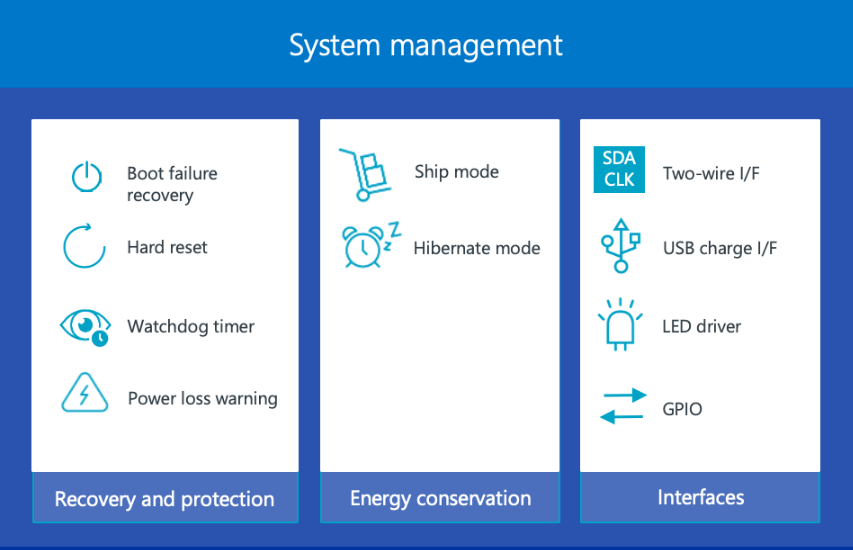
This section demonstrates how Nordic PMICs, such as nPM2100 and nPM1300/4, provide more than just voltage regulation and battery charging. These devices integrate system management features that help you design reliable and energy-efficient battery-powered products. It shows how Ship mode and Hibernate mode help minimize standby current and extend battery lifetime, especially in device applications that spend long periods in storage or deep sleep. It also shows how watchdog and boot monitoring features improve the system robustness by enabling automatic recovery from firmware faults or failed startup conditions.
Finally, we will explore the role of the battery fuel gauge. It estimates the battery’s state and remaining runtime with minimal power overhead. This allows you to accurately track available energy and design systems with more predictable battery lifetime.
Why PMIC system features matter
In many embedded products, the MCU is responsible for system control, while the PMIC provides power rails and charging. However, relying solely on the MCU for power management may create challenges.
Potential challenges might be, for example:
The MCU hangs due to firmware faults.
A device remains unused for months before the first activation.
A battery-powered product needs to sleep for long periods with minimal current consumption.
Startup failures leave a product permanently stuck in a non-functional state.
Nordic PMICs help address these challenges by providing system-level supervision and power control directly within the PMIC.
Ship mode
Many products are shipped with the battery already installed. Without proper power management, even a small standby current could slowly drain the battery before user even turn the device on.
The Ship mode solves this problem.
When the Ship mode is enabled:
The PMIC disconnects or disables all the supply rails.
Quiescent current is reduced to an extremely low level.
The system remains inactive until a defined wake event occurs.
Typical wake events include:
Button press
Charger insertion
External wake-up signal
Why this matters for nPM2100
The nPM2100 is designed specifically for primary battery applications, where every nanoamp matters.
One of its key features is its extremely low Ship mode current of ~35 nA.
This allows products to remain in storage for very long periods with minimal battery loss.
If you are designing long-life devices, Ship mode allows you to ship products with the battery installed without sacrificing shelf life. This ensures your device reaches users with the battery still nearly full, improving the overall user experience.
Hibernate mode in nPM2100
While the Ship mode is ideal for long-term storage, many devices need to wake periodically to perform tasks. In such cases, the system must remain in deep sleep while still supporting predictable wake-up events.
Hibernate mode in the nPM2100 enables ultra-low-power operation with controlled and fast wake-up, making it ideal for periodic sensing and low-duty-cycle wireless applications.
Wake-up from the Hibernate mode can occur through one of the following:
Wake-up timer
SHPHLD pin (external trigger)
Two Hibernate modes are available:
Hibernate – BOOST operates in ultra-low-power mode and LDOSW remains available, allowing limited system functionality. This mode is suitable for 1.5V batteries, like alkaline (for example, AA/AAA, LR44) and silver oxide (for example, SR44).
~250 nA with SHPHLD pin wake-up
~320 nA with wake-up timer
Hibernate_PT (pass-through) – BOOST is bypassed, reducing power further. This mode is suitable for 3 V batteries, such as lithium manganese dioxide (for example, CR2032), as long as the battery voltage is sufficient to power the system directly most of the time.
~90 nA with SHPHLD pin wake-up
~175 nA with wake-up timer
The following example illustrates how combining the nPM2100 Hibernate mode with the system-level power management significantly reduces sleep current and extends the battery life.
Note
Note: Compared to the Ship mode, the Hibernate modes consume more current but offer faster wake-up with possibility of timed wake-up.
System timer and monitor
Even well-tested firmware can occasionally fail due to unexpected interrupts, memory corruption, software bugs, or communication issues. If the MCU is stuck, the entire system might stop responding.
Nordic PMICs, such as nPM2100 and nPM1300/nPM1304, address this by integrating a flexible TIMER (timer/monitor) block, extending their role beyond power delivery to include system supervision and recovery. This helps ensure reliable operation even when the host MCU fails.
The PMIC TIMER (timer/monitor) block can be configured as:
Boot monitor – Verifies correct startup. If the host does not respond within a defined time, the PMIC triggers a reset or power cycle to prevent boot failure.
Watchdog timer – Ensures runtime operation. The MCU must periodically service it, otherwise the PMIC triggers a reset or power cycle, enabling recovery even if firmware becomes unresponsive.
Wake-up timer – Enables autonomous wake-up from the ultra-low-power Hibernate mode for periodic or event-driven operation.
General-purpose timer – Generates timed events for tasks, such as periodic housekeeping, low-frequency scheduling, or system timing, without MCU overhead.
By integrating timing and monitoring functions within the PMIC, systems achieve lower power consumption, reduced firmware complexity, and improved reliability, even when the MCU is inactive or unresponsive.
Fuel gauge
Battery-powered systems require accurate state-of-charge estimation beyond simple voltage measurement. OCV-based methods can be unreliable under varying load and temperature conditions, while coulomb counter–based techniques often require additional ICs and continuous power consumption, making them less suitable for ultra-low-power Bluetooth LE devices.
Nordic PMICs address this by providing an ultra-low-power, fully integrated fuel gauging solution that combines battery measurements with a model-based prediction algorithm to deliver accurate and stable state-of-charge estimation. This enables you to make informed decisions on power management strategies and transitions to ultra-low-power modes, while maintaining predictable battery behavior and improving the overall user experience.
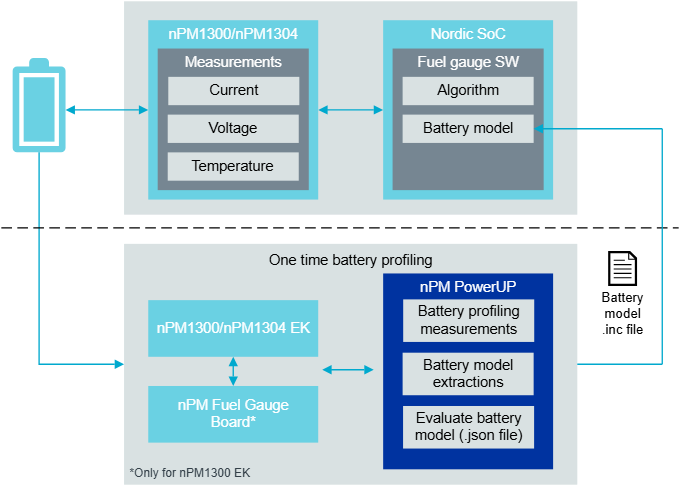
Nordic provides fuel gauge solutions for both rechargeable batteries (nPM1300/nPM1304) and primary batteries (nPM2100). In both cases, the fuel gauge algorithm runs on the host SoC (nRF52, nRF53, nRF54, and nRF91 Series), retrieving measurements from the PMIC over TWI to estimate the battery’s state of charge.
nPM1300/nPM1304 Fuel gauge
The nPM1300 and nPM1304 fuel gauges require a battery model to mathematically represent the battery behavior and predict the state of charge under varying conditions. Battery modeling is enabled by the nPM PowerUP app, available in the nRF Connect for Desktop.
The nPM PowerUP battery profiling solution lets you develop a battery model tailored to your battery characteristics. A one-time profiling in the app generates the model that you can evaluate before integrating it into your application. For details, see the Battery fuel gauge for IoT devices, application note Using the nPM1300 and nPM1304 Fuel Gauge and the nRF Connect SDK samples at nPM13xx Fuel gauge sample.
nPM2100 Fuel gauge
For primary batteries, the nPM2100 fuel gauge provides a simplified and optimized approach, tailored for single-use cells such as alkaline and coin cells.
It combines real-time voltage and temperature measurements with preconfigured battery models derived from extensive testing across different battery types and manufacturers. This enables reliable SoC estimation without the need for battery profiling or external components, making it ideal for low-power applications such as Bluetooth LE devices.
In this Privacy Policy you will find information on Nordic Semiconductor ASA (“Nordic Semiconductor”) processes your personal data when you use the Nordic Developer Academy.
References to “we” and “us” in this document refers to Nordic Semiconductor.
2. Our processing of personal data when you use the Nordic Developer Academy
2.1 Nordic Developer Academy
Nordic Semiconductor processes personal data in order to provide you with the features and functionality of the Nordic Developer Academy. Creating a user account is optional, but required if you want to track you progress and view your completed courses and obtained certificates. If you choose to create a user account, we will process the following categories of personal data:
Email
Name
Password (encrypted)
Course progression (e.g. which course you have completely or partly completed)
Certificate information, which consists of name of completed course and the validity of the certificate
Course results
During your use of the Nordic Developer Academy, you may also be asked if you want to provide feedback. If you choose to respond to any such surveys, we will also process the personal data in your responses in that survey.
The legal basis for this processing is GDPR article 6 (1) b. The processing is necessary for Nordic Semiconductor to provide the Nordic Developer Academy under the Terms of Service.
2.2 Analytics
If you consent to analytics, Nordic Semiconductor will use Google Analytics to obtain statistics about how the Nordic Developer Academy is used. This includes collecting information on for example what pages are viewed, the duration of the visit, the way in which the pages are maneuvered, what links are clicked, technical information about your equipment. The information is used to learn how Nordic Developer Academy is used and how the user experience can be further developed.
2.2 Newsletter
You can consent to receive newsletters from Nordic from within the Nordic Developer Academy. How your personal data is processed when you sign up for our newsletters is described in the Nordic Semiconductor Privacy Policy.
3. Retention period
We will store your personal data for as long you use the Nordic Developer Academy. If our systems register that you have not used your account for 36 months, your account will be deleted.
4. Additional information
Additional information on how we process personal data can be found in the Nordic Semiconductor Privacy Policy and Cookie Policy.
Nordic Developer Academy Terms of Service
1. Introduction
These terms and conditions (“Terms of Use”) apply to the use of the Nordic Developer Academy, provided by Nordic Semiconductor ASA, org. nr. 966 011 726, a public limited liability company registered in Norway (“Nordic Semiconductor”).
Nordic Developer Academy allows the user to take technical courses related to Nordic Semiconductor products, software and services, and obtain a certificate certifying completion of these courses. By completing the registration process for the Nordic Developer Academy, you are agreeing to be bound by these Terms of Use.
These Terms of Use are applicable as long as you have a user account giving you access to Nordic Developer Academy.
2. Access to and use of Nordic Developer Academy
Upon acceptance of these Terms of Use you are granted a non-exclusive right of access to, and use of Nordic Developer Academy, as it is provided to you at any time. Nordic Semiconductor provides Nordic Developer Academy to you free of charge, subject to the provisions of these Terms of Use and the Nordic Developer Academy Privacy Policy.
To access select features of Nordic Developer Academy, you need to create a user account. You are solely responsible for the security associated with your user account, including always keeping your login details safe.
You will able to receive an electronic certificate from Nordic Developer Academy upon completion of courses. By issuing you such a certificate, Nordic Semiconductor certifies that you have completed the applicable course, but does not provide any further warrants or endorsements for any particular skills or professional qualifications.
Nordic Semiconductor will continuously develop Nordic Developer Academy with new features and functionality, but reserves the right to remove or alter any existing functions without notice.
3. Acceptable use
You undertake that you will use Nordic Developer Academy in accordance with applicable law and regulations, and in accordance with these Terms of Use. You must not modify, adapt, or hack Nordic Developer Academy or modify another website so as to falsely imply that it is associated with Nordic Developer Academy, Nordic Semiconductor, or any other Nordic Semiconductor product, software or service.
You agree not to reproduce, duplicate, copy, sell, resell or in any other way exploit any portion of Nordic Developer Academy, use of Nordic Developer Academy, or access to Nordic Developer Academy without the express written permission by Nordic Semiconductor. You must not upload, post, host, or transmit unsolicited email, SMS, or \”spam\” messages.
You are responsible for ensuring that the information you post and the content you share does not;
contain false, misleading or otherwise erroneous information
infringe someone else’s copyrights or other intellectual property rights
contain sensitive personal data or
contain information that might be received as offensive or insulting.
Such information may be removed without prior notice.
Nordic Semiconductor reserves the right to at any time determine whether a use of Nordic Developer Academy is in violation of its requirements for acceptable use.
Violation of the at any time applicable requirements for acceptable use may result in termination of your account. We will take reasonable steps to notify you and state the reason for termination in such cases.
4. Routines for planned maintenance
Certain types of maintenance may imply a stop or reduction in availability of Nordic Developer Academy. Nordic Semiconductor does not warrant any level of service availability but will provide its best effort to limit the impact of any planned maintenance on the availability of Nordic Developer Academy.
5. Intellectual property rights
Nordic Semiconductor retains all rights to all elements of Nordic Developer Academy. This includes, but is not limited to, the concept, design, trademarks, know-how, trade secrets, copyrights and all other intellectual property rights.
Nordic Semiconductor receives all rights to all content uploaded or created in Nordic Developer Academy. You do not receive any license or usage rights to Nordic Developer Academy beyond what is explicitly stated in this Agreement.
6. Liability and damages
Nothing within these Terms of Use is intended to limit your statutory data privacy rights as a data subject, as described in the Nordic Developer Academy Privacy Policy. You acknowledge that errors might occur from time to time and waive any right to claim for compensation as a result of errors in Nordic Developer Academy. When an error occurs, you shall notify Nordic Semiconductor of the error and provide a description of the error situation.
You agree to indemnify Nordic Semiconductor for any loss, including indirect loss, arising out of or in connection with your use of Nordic Developer Academy or violations of these Terms of Use. Nordic Semiconductor shall not be held liable for, and does not warrant that (i) Nordic Developer Academy will meet your specific requirements, (ii) Nordic Developer Academy will be uninterrupted, timely, secure, or error-free, (iii) the results that may be obtained from the use of Nordic Developer Academy will be accurate or reliable, (iv) the quality of any products, services, information, or other material purchased or obtained by you through Nordic Developer Academy will meet your expectations, or that (v) any errors in Nordic Developer Academy will be corrected.
You accept that this is a service provided to you without any payment and hence you accept that Nordic Semiconductor will not be held responsible, or liable, for any breaches of these Terms of Use or any loss connected to your use of Nordic Developer Academy. Unless otherwise follows from mandatory law, Nordic Semiconductor will not accept any such responsibility or liability.
7. Change of terms
Nordic Semiconductor may update and change the Terms of Use from time to time. Nordic Semiconductor will seek to notify you about significant changes before such changes come into force and give you a possibility to evaluate the effects of proposed changes. Continued use of Nordic Developer Academy after any such changes shall constitute your acceptance of such changes. You can review the current version of the Terms of Use at any time at https://academy.nordicsemi.com/terms-of-service/
8. Transfer of rights
Nordic Semiconductor is entitled to transfer its rights and obligation pursuant to these Terms of Use to a third party as part of a merger or acquisition process, or as a result of other organizational changes.
9. Third Party Services
To the extent Nordic Developer Academy facilitates access to services provided by a third party, you agree to comply with the terms governing such third party services. Nordic Semiconductor shall not be held liable for any errors, omissions, inaccuracies, etc. related to such third party services.
10. Dispute resolution
The Terms of Use and any other legally binding agreement between yourself and Nordic Semiconductor shall be subject to Norwegian law and Norwegian courts’ exclusive jurisdiction.
Switch language?
Progress is tracked separately for each language. Switching will continue from your progress in that language or start fresh if you haven't begun.
Your current progress is saved, and you can switch back anytime.
•This release includes Long-Term Support (LTS) for five years.
•Patch (minor) releases will address security vulnerabilities and critical bug fixes.
•API stability is guaranteed; breaking changes are only introduced when required by a security fix.
•Notifications for critical bug fixes and security updates via the myNordic notification system (mynordic.nordicsemi.com)
General updates
•Support for nRF54LS05 DK (Available through the early access sampling program) •Support for the nRF54LM20B with Axon NPU for Edge AI applications
Bluetooth LE updates
•Quality of Service module is now production-ready. •New experimental features for RF testing (Direct Test Mode) and low-latency packet handling (LE Flushable ACL).
MCUboot & Partition Manager
•Single-Slot DFU and RAM Load mode are both promoted to fully supported •Partition Manager is officially deprecated in favor of Zephyr's devicetree-based partitioning.