Designing Low-Power Bluetooth LE Products

Changing the version will not affect your certificate
Design
Lesson 1 – Power consumption essentials
4 Topics | 1 Quiz
A typical Bluetooth LE product architecture
Bluetooth LE communication methods
Electrical quantities
Exercise 1 – Estimating power budget
Lesson 1 quiz
Lesson 2 – Designing with a Nordic PMIC
7 Topics | 1 Quiz
PMIC overview
System management features with Nordic PMICs
System efficiency considerations
PMIC hardware integration
PMIC software integration
Getting started with Nordic PMICs
Exercise 1 – Powering nRF54L devices from a single AA/AAA battery
Lesson 2 quiz
Measure
Lesson 3 – Tools and best practices for power measurement
5 Topics | 1 Quiz
Current measurement fundamentals
Current measurement equipment: Capabilities, limitations, and best practices
Measurement setup validation and error mitigation
Exercise 1 – Setup verification using System OFF
Exercise 2 – Bluetooth LE advertising power profiling and data extrapolation
Lesson 3 quiz
Optimize
Lesson 4 – Bluetooth LE power optimization
4 Topics | 1 Quiz
Bluetooth LE advertising parameters and power consumption
Bluetooth LE connection parameters and power consumption
Exercise 1 – Optimizing power consumption during Bluetooth LE advertising
Exercise 2 – Optimizing power consumption in a Bluetooth LE connection
Lesson 4 quiz
Lesson 5 – SoC specific power optimization I
6 Topics | 1 Quiz
Clock sources
Peripherals
Memory retention and sleep modes
Exercise 1 – Estimating and measuring how clock sources affect power consumption
Exercise 2 – Comparing current consumption of peripherals from different power domains
Exercise 3 – Measuring the impact of RAM retention settings
Lesson 5 quiz
Lesson 6 – SoC specific power optimization II
6 Topics | 1 Quiz
GPIO interrupt types on the nRF54L Series
DPPI Distributed programmable peripheral interconnect
Direct Memory Access (EasyDMA)
Exercise 1 – Measuring sleep current with different GPIO interrupt types
Exercise 2 – Reducing CPU activity by connecting peripherals with DPPI
Exercise 3 – Reducing current consumption with EasyDMA
Lesson 6 quiz
Monitor
Lesson 7 – Remote monitoring of Bluetooth LE devices with nRF Cloud
8 Topics | 1 Quiz
Why remote observability matters for low-power Bluetooth LE devices
Key data points for Bluetooth LE connection stability and power efficiency
Integrating the Memfault SDK into a Bluetooth LE peripheral application
Fleet-wide analysis and debugging with nRF Cloud
Exercise 1 – Setting up the Memfault SDK on an nRF54L Series DK
Exercise 2 – Exploring the automatically collected Bluetooth LE metrics
Exercise 3 – Observing the impact of connection parameter changes on metrics
Exercise 4 – Invoking a firmware update over Bluetooth LE (OTA)
Lesson 7 quiz
Get your certificate!
Feedback
Feedback

If you are having issues with the exercises, please create a ticket on DevZone: devzone.nordicsemi.com
Drag & Drop Files, Choose Files to Upload You can upload up to 2 files.
Loading
RegisterLog in

PMIC hardware integration

When designing ultra-low-power wireless devices using Nordic Semiconductor’s SoCs like the nRF54L Series, integrating a dedicated Power Management IC (PMIC) is essential for maximizing the battery life and system reliability. Whether you are using the nPM1300 for rechargeable Li-ion/Li-poly applications or the nPM2100 for primary battery designs (such as, coin cell or alkaline) , proper hardware integration defines the performance of your end product.

This section explores the key hardware integration considerations, focusing on rail separation, I/O voltage management, battery power budgets, and power sequencing.

Current requirements

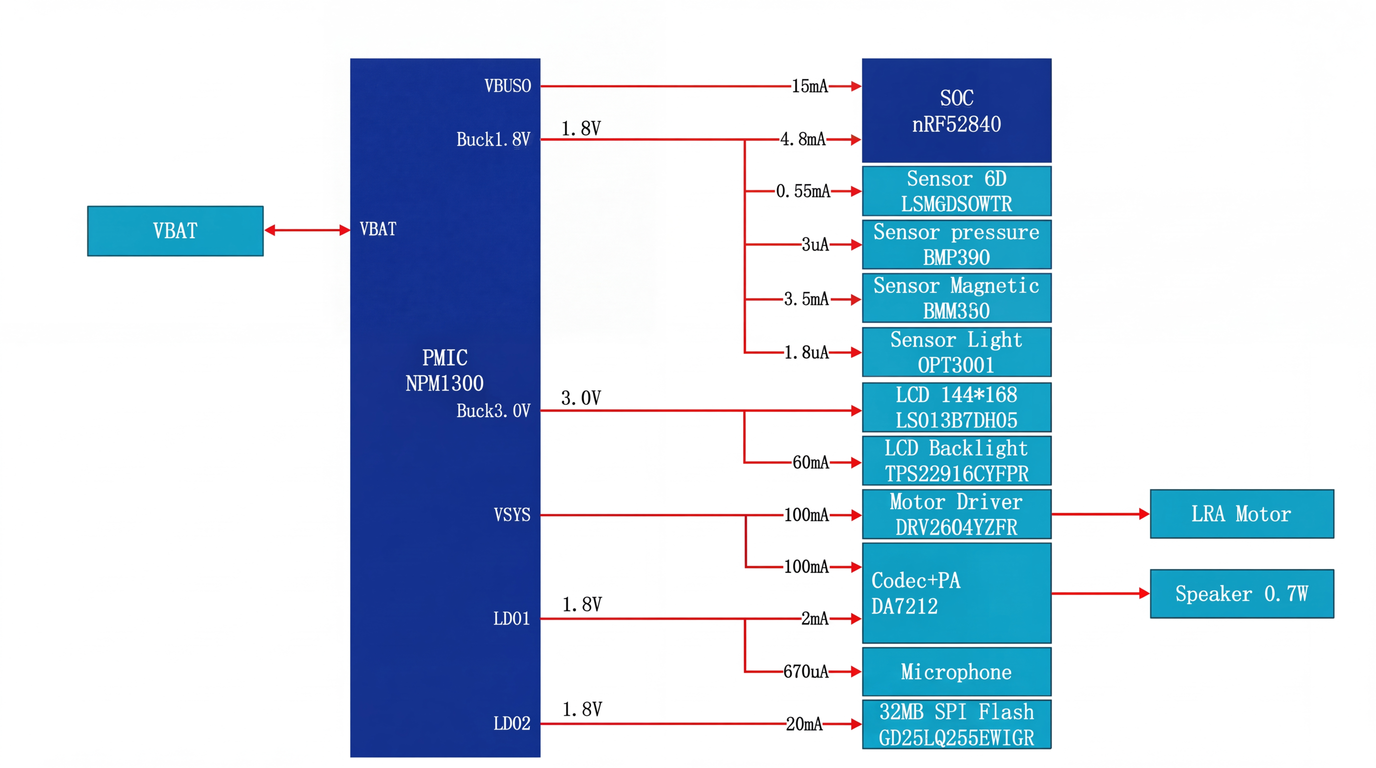
Ensure that the selected rail can handle the peak current of the load. The nPM1300 provides two 200 mA Buck regulators and two 50 mA/100 mA LDO/Load switches. The nPM2100 provides up to 150 mA from its Boost regulator and 50 mA from its LDOSW. High-current peripherals (such as LEDs, motors) should be placed on a separate rail from the SoC to prevent heavy load transients from inducing voltage droop on the radio supply.

When planning the power budget for each rail or trying to determine which rails can be combined based on power consumption, looking at the average current is not enough. The designer must take the worst case scenario transient events into account to be sure not to overpower the regulator. Typically, a headroom of 30% should be enough, which means that the average current should be at most about 70% of the regulator’s maximum current rating. IC manufacturers have different solutions for evaluating the maximum current draw during transients. Nordic Semiconductor has the Online Power Profiler tool to help with this.

Fast current transients in the power rail may lead to the voltage dropping (or increasing) suddenly. For this reason, droop sensitive rails like the SoC VDD should not be combined with devices such as a motor driver, to avoid the VDD drooping possibly below the reset level. The linear resonant actuator (LRA) motor might create transient spikes of 100-200 mA in microseconds.

The following block diagram shows how an open-source Pebble 2 Duo smartwatch uses Nordic Semiconductor’s PMIC and SoC. The design files for this project can be found here.

An example of multi-power rail product

I/O voltages and level shifting

A common hardware design challenge is matching the I/O logic levels between the SoC and external peripherals. Level shifters introduce additional cost and complexity, PCB area, and quiescent current leakage, and are usually undesirable in ultra-low-power designs.

Sharing a rail or separate rails

  • Shared rail (Ideal): Operating the SoC and all peripherals at a unified voltage (for example, 1.8 V) allows them to share a single high-efficiency PMIC output (for example, BUCK1). This inherently solves the I/O mismatch and eliminates the need for level shifters.
  • Separate rails (Mixed-voltage): In some cases, the peripheral has separate VDD and VDDIO pins for the core and I/O, respectively. In such cases, it makes sense to use multiple PMIC rails to match the I/O voltage between devices to avoid using level shifters. For example, if the SoC runs at 1.8 V but a sensor requires 3 V to operate and has a separate VDDIO pin, one of the PMIC rails could be configured to supply 3 V and take the I/O supply from the SoC rail. In this case, close attention must be paid to sequencing, which will be covered later.

Design takeaway: Always attempt to unify I/O voltages. If mixed voltages are unavoidable, look for peripherals with dedicated VDDIO pins and power them from the same PMIC rail that supplies the nRF SoC.

Current requirements and battery power budgeting

Many devices are characterized by long periods of deep sleep punctuated by short, high-current pulses during RF transmission or sensor sampling. The battery’s Equivalent Series Resistance (ESR) plays a major role in the system stability.

Primary batteries (nPM2100)

Coin cells (for example, CR2032) have notoriously high ESR. Drawing a 15 mA Bluetooth LE TX pulse directly from a coin cell can cause the battery voltage to collapse, triggering a brownout reset (BOR).

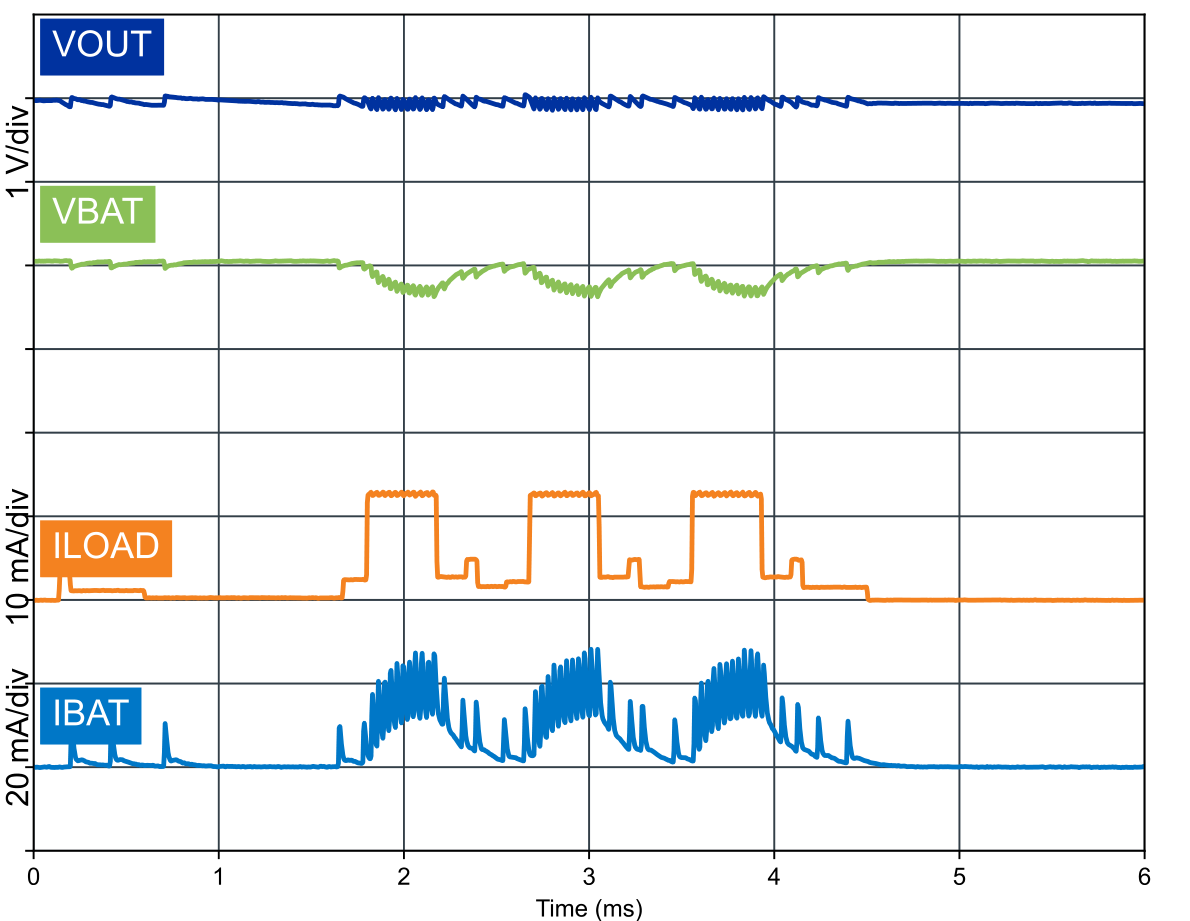
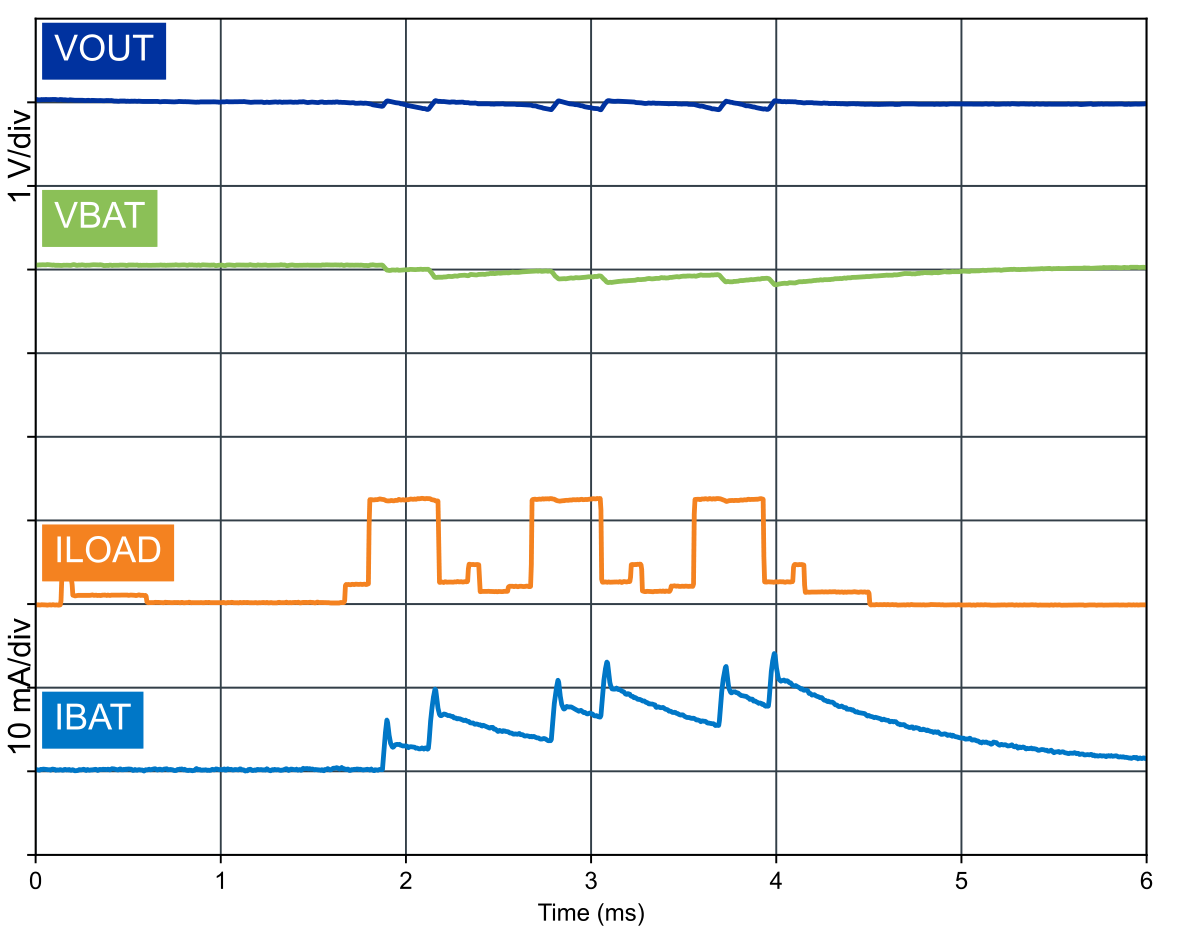
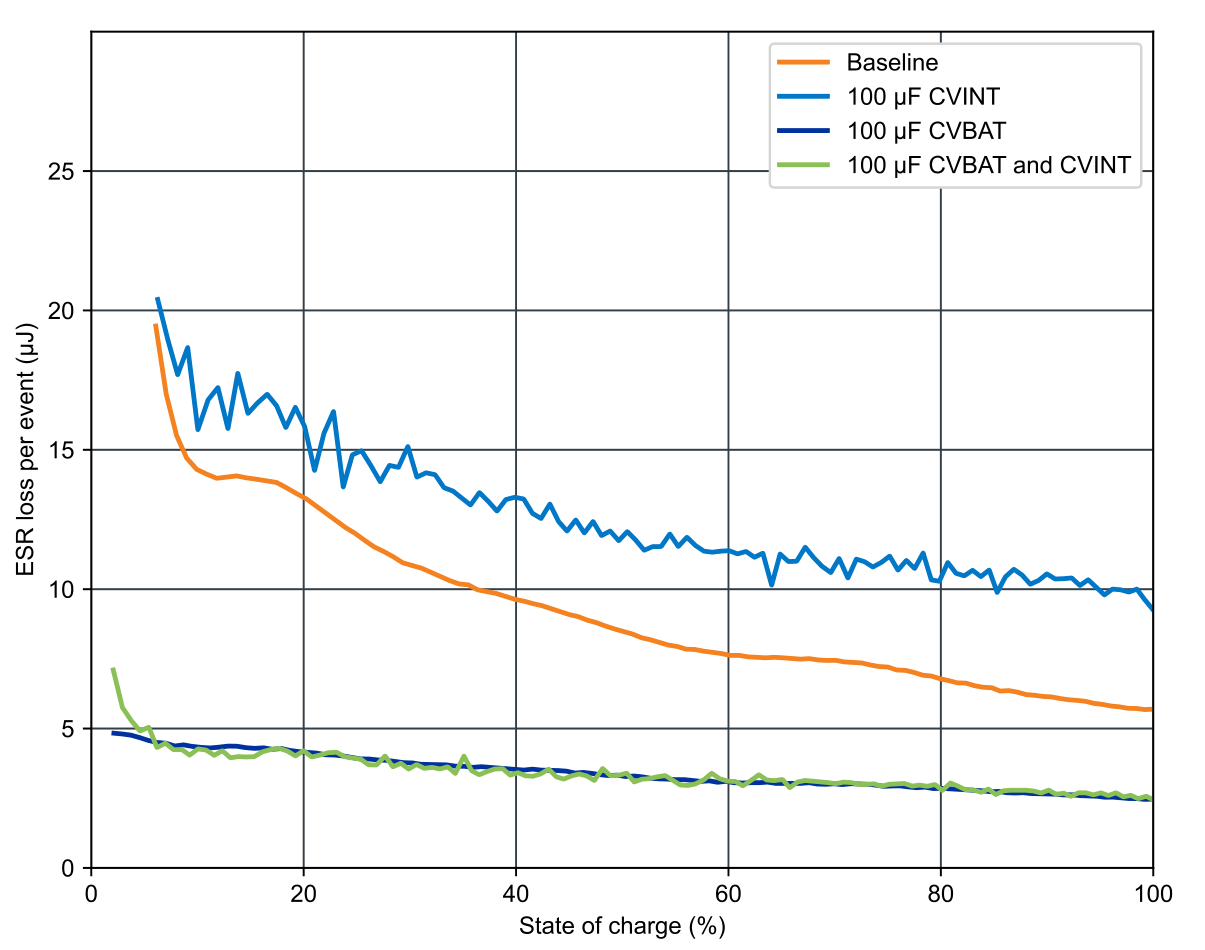
The nPM2100 features a Prevent High Power (NOHP) mode, which prevents the boost from entering high power mode. This decreases the maximum current drawn from the battery. Combined with proper bulk capacitance (for example, 100 µF on both VBAT and VINT), the capacitor acts as a local energy reservoir, smoothing out the peak current drawn from the battery. This also increases battery life. Below are graphs and a table showing the improvements with different capacitor configurations.

The below values and graphs are from the nPM2100 hardware design guidelines.

CapacitorsBattery-life difference
Default capacitors: CVBAT: 10 µF + 1 nF COUT: 10 µF + 2.2 µF + 1 nFBaseline
+100 µF at VINT+2.7%
+100 µF at VBAT+11.6%
+100 µF at VINT and VBAT+17.9%
Response to Bluetooth LE event, default capacitors
Response to Bluetooth LE event, 100 µF added to the boost regulator input and output
ESR losses for each Bluetooth LE event in discharge test

Rechargeable batteries (nPM1300)

Li-ion and Li-poly batteries have much lower ESR and can easily handle peak currents. However, PCB trace inductance and PMIC input/output capacitance are still critical. A minimum of 10 µF on the buck inputs (PVDD) and outputs (VOUT1 and VOUT2) is required to ensure regulator stability and prevent voltage droops during sudden inrush currents when enabling load switches.

Power sequencing: GPIO vs. TWI control

Proper power sequencing ensures that peripherals are not back-fed through their I/O lines before their main power is applied, which can cause parasitic battery drain or latch-up states. Nordic PMICs offer two primary methods for controlling power rails dynamically.

TWI (I²C compatible) sequencing

Upon boot, the nRF SoC relies on the PMIC’s hardware default voltages (configured over the VSET pins). Once the SoC boots, it uses the Two-Wire Interface (TWI) to configure the PMIC registers.

  • Use case: Best for general initialization, configuring LDO output voltages, and entering deep sleep modes (Ship/Hibernate).
  • Drawback: TWI transactions take time. If a sensor needs to be powered on and off rapidly to save power, the I²C bus overhead might consume more energy than it saves.

GPIO sequencing

Nordic PMICs allow their regulators (bucks, LDOs, and load switches) to be mapped to dedicated PMIC GPIO pins. These pins can be driven directly by the nRF SoC’s GPIOs or by other logic pins on peripheral devices.

  • Use case: Best for latency-critical, highly precise sequencing. Using the nRF SoC’s Distributed Programmable Peripheral Interconnect (DPPI) and a hardware timer, the SoC can toggle a GPIO to enable the nPM1300 load switch before taking a sensor reading, and disable it immediately after.
  • Implementation: Configure the PMIC over the TWI at boot to assign LDSW1 to PMIC_GPIO0. From then on, toggling the SoC’s hardware pin instantly turns the sensor power on or off.

GPIOs, as well as TWI, can also be used to change the operation state of a regulator. This is useful, for example, when operating a buck in Hysteretic mode during idle operation, but switching to PWM mode for better and cleaner voltage regulation before an expected load event occurs.

Managing noise

Radio transceivers and high-resolution analog sensors are highly susceptible to power supply noise. Switching regulators (buck/boost) are highly efficient but can introduce voltage ripple.

  • For the SoC/radio: Nordic PMICs feature an automatic mode transition (Auto mode). During heavy loads or RF transmission, the PMIC automatically switches to a low-noise, fixed-frequency Pulse Width Modulation (PWM) mode, which is easier to filter due to the known switching frequency. During sleep, it reverts to a highly efficient Hysteretic mode.
  • For sensitive sensors: If your design includes highly sensitive analog sensors, consider powering them through the integrated LDO/load switch (LDOSW) rather than directly from a buck/boost output. The LDO provides a high Power Supply Rejection Ratio (PSRR) and filters out the switching noise.

While for some peripherals, an LDO might be the obvious choice due to the lower noise levels, some designs might still benefit from powering these with a buck due to better efficiency. If the sensor needs to be powered most of the time the device is on, it might be beneficial to sacrifice some accuracy to gain battery life. Also, if the peripheral is powered when the SoC is powered, it might make sense to use the same rail to save on regulators.

It is also possible to first regulate down from the battery with a buck converter and then further regulate this with an LDO. This way, energy is saved as the LDO does not waste as much energy as heat. For example, a buck regulator could regulate the battery voltage from about 3.7 V to 2.6 V. The LDO would further regulate this down to 1.8 V. However, this is often not feasible in area-constrained designs.

Make sure to Log in or Register to save your progress

Back
Next

Nordic Developer Academy Privacy Policy


1. Introduction 

In this Privacy Policy you will find information on Nordic Semiconductor ASA (“Nordic Semiconductor”) processes your personal data when you use the Nordic Developer Academy.

References to “we” and “us” in this document refers to Nordic Semiconductor.


2. Our processing of personal data when you use the Nordic Developer Academy 

2.1 Nordic Developer Academy 

Nordic Semiconductor processes personal data in order to provide you with the features and functionality of the Nordic Developer Academy. Creating a user account is optional, but required if you want to track you progress and view your completed courses and obtained certificates. If you choose to create a user account, we will process the following categories of personal data:

  • Email
  • Name
  • Password (encrypted)
  • Course progression (e.g. which course you have completely or partly completed)
  • Certificate information, which consists of name of completed course and the validity of the certificate
  • Course results

During your use of the Nordic Developer Academy, you may also be asked if you want to provide feedback. If you choose to respond to any such surveys, we will also process the personal data in your responses in that survey.

The legal basis for this processing is GDPR article 6 (1) b. The processing is necessary for Nordic Semiconductor to provide the Nordic Developer Academy under the Terms of Service.


2.2 Analytics 

If you consent to analytics, Nordic Semiconductor will use Google Analytics to obtain statistics about how the Nordic Developer Academy is used. This includes collecting information on for example what pages are viewed, the duration of the visit, the way in which the pages are maneuvered, what links are clicked, technical information about your equipment. The information is used to learn how Nordic Developer Academy is used and how the user experience can be further developed.


2.2 Newsletter 

You can consent to receive newsletters from Nordic from within the Nordic Developer Academy. How your personal data is processed when you sign up for our newsletters is described in the Nordic Semiconductor Privacy Policy.


3. Retention period 

We will store your personal data for as long you use the Nordic Developer Academy. If our systems register that you have not used your account for 36 months, your account will be deleted.


4. Additional information 

Additional information on how we process personal data can be found in the Nordic Semiconductor Privacy Policy and Cookie Policy.

‍‍ 

Nordic Developer Academy Terms of Service


1. Introduction

‍These terms and conditions (“Terms of Use”) apply to the use of the Nordic Developer Academy, provided by Nordic Semiconductor ASA, org. nr. 966 011 726, a public limited liability company registered in Norway (“Nordic Semiconductor”). ‍

Nordic Developer Academy allows the user to take technical courses related to Nordic Semiconductor products, software and services, and obtain a certificate certifying completion of these courses. By completing the registration process for the Nordic Developer Academy, you are agreeing to be bound by these Terms of Use.

These Terms of Use are applicable as long as you have a user account giving you access to Nordic Developer Academy.‍

‍2. Access to and use of Nordic Developer Academy

‍‍Upon acceptance of these Terms of Use you are granted a non-exclusive right of access to, and use of Nordic Developer Academy, as it is provided to you at any time. Nordic Semiconductor provides Nordic Developer Academy to you free of charge, subject to the provisions of these Terms of Use and the Nordic Developer Academy Privacy Policy.

To access select features of Nordic Developer Academy, you need to create a user account. You are solely responsible for the security associated with your user account, including always keeping your login details safe.

You will able to receive an electronic certificate from Nordic Developer Academy upon completion of courses. By issuing you such a certificate, Nordic Semiconductor certifies that you have completed the applicable course, but does not provide any further warrants or endorsements for any particular skills or professional qualifications.

Nordic Semiconductor will continuously develop Nordic Developer Academy with new features and functionality, but reserves the right to remove or alter any existing functions without notice.

‍3. Acceptable use

You undertake that you will use Nordic Developer Academy in accordance with applicable law and regulations, and in accordance with these Terms of Use.‍ You must not modify, adapt, or hack Nordic Developer Academy or modify another website so as to falsely imply that it is associated with Nordic Developer Academy, Nordic Semiconductor, or any other Nordic Semiconductor product, software or service.

You agree not to reproduce, duplicate, copy, sell, resell or in any other way exploit any portion of Nordic Developer Academy, use of Nordic Developer Academy, or access to Nordic Developer Academy without the express written permission by Nordic Semiconductor. You must not upload, post, host, or transmit unsolicited email, SMS, or \”spam\” messages.

You are responsible for ensuring that the information you post and the content you share does not;

  • contain false, misleading or otherwise erroneous information
  • infringe someone else’s copyrights or other intellectual property rights
  • contain sensitive personal data or
  • contain information that might be received as offensive or insulting.
  • Such information may be removed without prior notice.

‍Nordic Semiconductor reserves the right to at any time determine whether a use of Nordic Developer Academy is in violation of its requirements for acceptable use.

Violation of the at any time applicable requirements for acceptable use may result in termination of your account. We will take reasonable steps to notify you and state the reason for termination in such cases.

‍4. Routines for planned maintenance

‍Certain types of maintenance may imply a stop or reduction in availability of Nordic Developer Academy. Nordic Semiconductor does not warrant any level of service availability but will provide its best effort to limit the impact of any planned maintenance on the availability of Nordic Developer Academy.

5. Intellectual property rights

‍Nordic Semiconductor retains all rights to all elements of Nordic Developer Academy. This includes, but is not limited to, the concept, design, trademarks, know-how, trade secrets, copyrights and all other intellectual property rights.

Nordic Semiconductor receives all rights to all content uploaded or created in Nordic Developer Academy. You do not receive any license or usage rights to Nordic Developer Academy beyond what is explicitly stated in this Agreement.

‍6. Liability and damages

‍Nothing within these Terms of Use is intended to limit your statutory data privacy rights as a data subject, as described in the Nordic Developer Academy Privacy Policy. ‍You acknowledge that errors might occur from time to time and waive any right to claim for compensation as a result of errors in Nordic Developer Academy. When an error occurs, you shall notify Nordic Semiconductor of the error and provide a description of the error situation.

You agree to indemnify Nordic Semiconductor for any loss, including indirect loss, arising out of or in connection with your use of Nordic Developer Academy or violations of these Terms of Use. ‍Nordic Semiconductor shall not be held liable for, and does not warrant that (i) Nordic Developer Academy will meet your specific requirements, (ii) Nordic Developer Academy will be uninterrupted, timely, secure, or error-free, (iii) the results that may be obtained from the use of Nordic Developer Academy will be accurate or reliable, (iv) the quality of any products, services, information, or other material purchased or obtained by you through Nordic Developer Academy will meet your expectations, or that (v) any errors in Nordic Developer Academy will be corrected.

You accept that this is a service provided to you without any payment and hence you accept that Nordic Semiconductor will not be held responsible, or liable, for any breaches of these Terms of Use or any loss connected to your use of Nordic Developer Academy. Unless otherwise follows from mandatory law, Nordic Semiconductor will not accept any such responsibility or liability.

‍7. Change of terms

‍Nordic Semiconductor may update and change the Terms of Use from time to time. Nordic Semiconductor will seek to notify you about significant changes before such changes come into force and give you a possibility to evaluate the effects of proposed changes. Continued use of Nordic Developer Academy after any such changes shall constitute your acceptance of such changes. You can review the current version of the Terms of Use at any time at https://academy.nordicsemi.com/terms-of-service/

‍8. Transfer of rights

‍Nordic Semiconductor is entitled to transfer its rights and obligation pursuant to these Terms of Use to a third party as part of a merger or acquisition process, or as a result of other organizational changes.

‍9. Third Party Services

‍‍To the extent Nordic Developer Academy facilitates access to services provided by a third party, you agree to comply with the terms governing such third party services. Nordic Semiconductor shall not be held liable for any errors, omissions, inaccuracies, etc. related to such third party services.

‍10. Dispute resolution

‍‍The Terms of Use and any other legally binding agreement between yourself and Nordic Semiconductor shall be subject to Norwegian law and Norwegian courts’ exclusive jurisdiction.

 

Switch language?

Progress is tracked separately for each language. Switching will continue from your progress in that language or start fresh if you haven't begun.

Your current progress is saved, and you can switch back anytime.

Log in
Don’t have an account? Register an account

Forgot your password?
Register an account
Already have an account? Log in
(All fields are required unless specified optional)

  • 8 or more characters
  • Upper and lower case letters
  • At least one number or special character

Forgot your password?
Enter the email associated with your account, and we will send you a link to reset your password.

Back to Log in

Insert/edit link

Enter the destination URL

Or link to existing content

    No search term specified. Showing recent items. Search or use up and down arrow keys to select an item.

      Change summary

      What's new in the latest version

      General updates

      General updates

      •Support for nRF54LS05 DK (Available through the early access sampling program)
      •Support for the nRF54LM20B with Axon NPU for Edge AI applications
      Bluetooth LE updates

      Bluetooth LE updates

      •Quality of Service module is now production-ready.
      •New experimental features for RF testing (Direct Test Mode) and low-latency packet handling (LE Flushable ACL).
      MCUboot & Partition Manager

      MCUboot & Partition Manager

      •Single-Slot DFU and RAM Load mode are both promoted to fully supported
      •Partition Manager is officially deprecated in favor of Zephyr's devicetree-based partitioning.