Designing Low-Power Bluetooth LE Products

Changing the version will not affect your certificate
Design
Lesson 1 – Power consumption essentials
4 Topics | 1 Quiz
A typical Bluetooth LE product architecture
Bluetooth LE communication methods
Electrical quantities
Exercise 1 – Estimating power budget
Lesson 1 quiz
Lesson 2 – Designing with a Nordic PMIC
7 Topics | 1 Quiz
PMIC overview
System management features with Nordic PMICs
System efficiency considerations
PMIC hardware integration
PMIC software integration
Getting started with Nordic PMICs
Exercise 1 – Powering nRF54L devices from a single AA/AAA battery
Lesson 2 quiz
Measure
Lesson 3 – Tools and best practices for power measurement
5 Topics | 1 Quiz
Current measurement fundamentals
Current measurement equipment: Capabilities, limitations, and best practices
Measurement setup validation and error mitigation
Exercise 1 – Setup verification using System OFF
Exercise 2 – Bluetooth LE advertising power profiling and data extrapolation
Lesson 3 quiz
Optimize
Lesson 4 – Bluetooth LE power optimization
4 Topics | 1 Quiz
Bluetooth LE advertising parameters and power consumption
Bluetooth LE connection parameters and power consumption
Exercise 1 – Optimizing power consumption during Bluetooth LE advertising
Exercise 2 – Optimizing power consumption in a Bluetooth LE connection
Lesson 4 quiz
Lesson 5 – SoC specific power optimization I
6 Topics | 1 Quiz
Clock sources
Peripherals
Memory retention and sleep modes
Exercise 1 – Estimating and measuring how clock sources affect power consumption
Exercise 2 – Comparing current consumption of peripherals from different power domains
Exercise 3 – Measuring the impact of RAM retention settings
Lesson 5 quiz
Lesson 6 – SoC specific power optimization II
6 Topics | 1 Quiz
GPIO interrupt types on the nRF54L Series
DPPI Distributed programmable peripheral interconnect
Direct Memory Access (EasyDMA)
Exercise 1 – Measuring sleep current with different GPIO interrupt types
Exercise 2 – Reducing CPU activity by connecting peripherals with DPPI
Exercise 3 – Reducing current consumption with EasyDMA
Lesson 6 quiz
Monitor
Lesson 7 – Remote monitoring of Bluetooth LE devices with nRF Cloud
8 Topics | 1 Quiz
Why remote observability matters for low-power Bluetooth LE devices
Key data points for Bluetooth LE connection stability and power efficiency
Integrating the Memfault SDK into a Bluetooth LE peripheral application
Fleet-wide analysis and debugging with nRF Cloud
Exercise 1 – Setting up the Memfault SDK on an nRF54L Series DK
Exercise 2 – Exploring the automatically collected Bluetooth LE metrics
Exercise 3 – Observing the impact of connection parameter changes on metrics
Exercise 4 – Invoking a firmware update over Bluetooth LE (OTA)
Lesson 7 quiz
Get your certificate!
Feedback
Feedback

If you are having issues with the exercises, please create a ticket on DevZone: devzone.nordicsemi.com
Drag & Drop Files, Choose Files to Upload You can upload up to 2 files.
Loading
RegisterLog in

Current measurement equipment: Capabilities, limitations, and best practices

In this topic, we will cover the capabilities, limitations, and best practices of different equipment: power analyzers/SMU, oscilloscopes, and multimeters, and when to use each.

Power analyzer/SMU

The most complete tool for current measurements and power profiling is a power analyzer or SMU (Source Measuring Unit). SMUs, in addition to measuring the current, also supplies the voltage to the device under test (DUT). Power analyzers can often act as an SMU, or it can act as an ampere meter, where the voltage is supplied externally, and the current is measured in series with the DUT. The terms SMU and power analyzer is often used interchangeably.

The most important aspects of power analyzers is that they have automatic range switching, so we get a very large dynamic range. They usually also have quite good sample rate, giving us a detailed plot timewise. But this of course varies from equipment to equipment.

Limitations with dynamic range switching

As mentioned above, when the current increases or decreases, the measurement shunt value will be changed. This change leads to a change on the output impedance of the voltage source. Or in other words, there will be a sudden voltage step or drop on VDD, when the the measurement range changes. Since we have decoupling capacitors on VDD, the sudden jump in voltage will lead to an inrush to the decopling capacitors, or the oposite when voltage drops. This can be seen as a spike or overshoot on the current plot whenever there is a large positive change in current consumption, or undershoot when the current drops.

Many power analyzers will compensate for this in software. But how well this is done, depends on the tool.

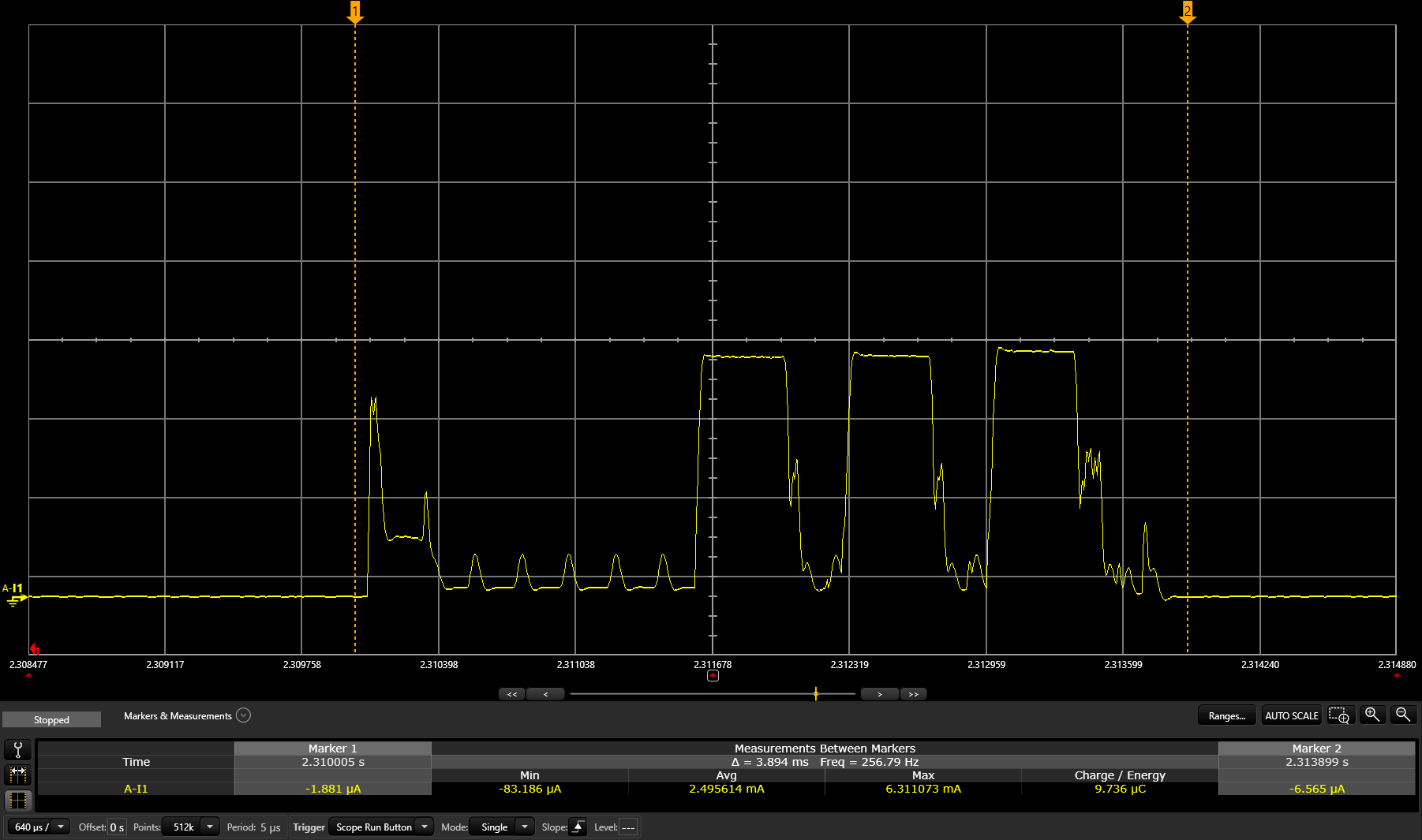
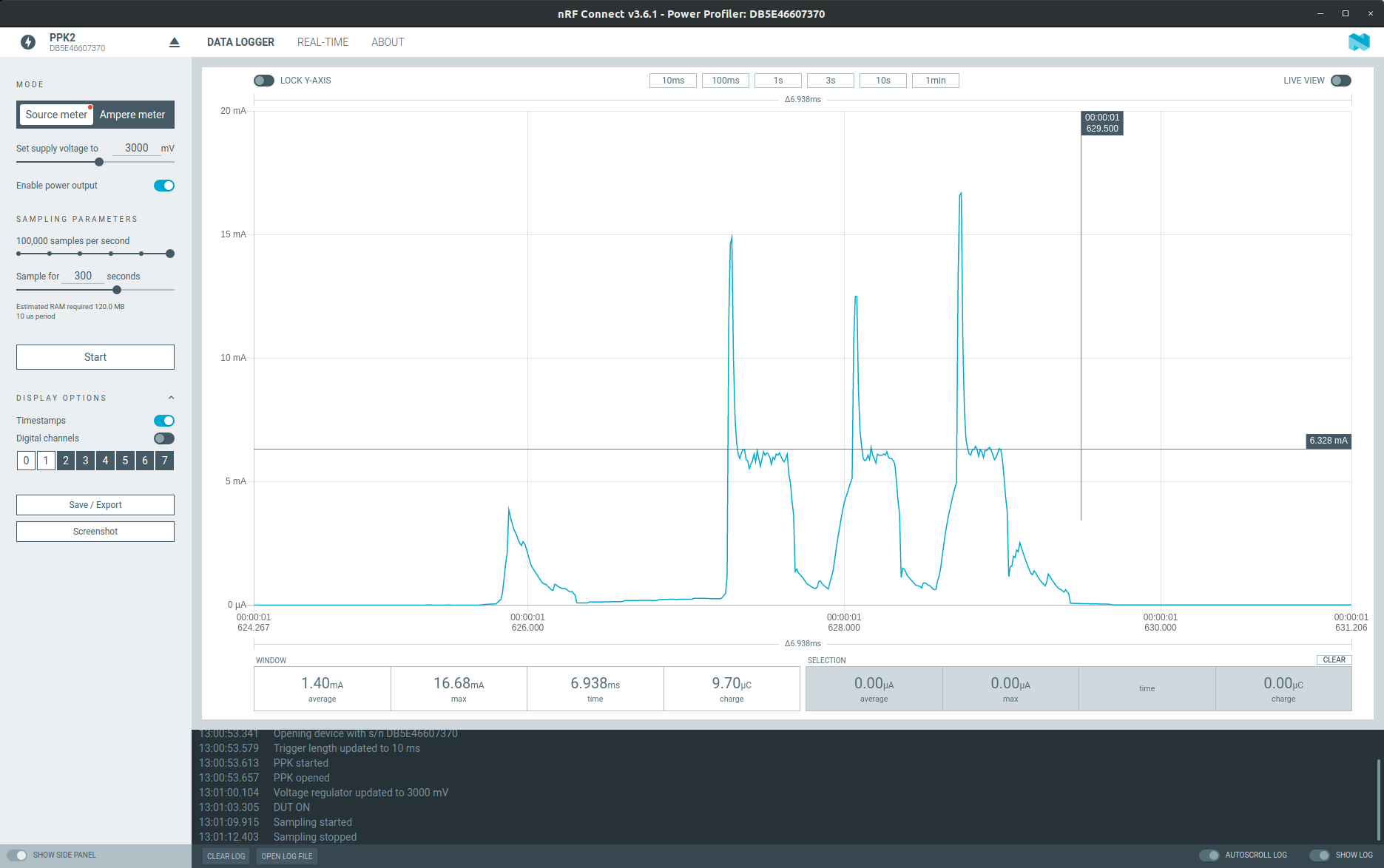
Here is a comparison between the PPK and professional lab equipment, Keysight power analyzer. The Keysight power analyzer is much better at compensating for this inrush current. It is important to note that the total charge/energy will (should) still be the same.

Power analyzerPPK

Oscilloscope

If we need to inspect the power profile with detail, and we do not have access to a good power analyzer, using a scope can be a solution.

This method involves manually adding a fixed measurement shunt in series with the DUT, and then measure the voltage drop with the scope. This also means that we can not have dynamic range switching in this setup, which results in a limited use case.

Measure the current profile of an nRF54L15 DK with an oscilloscope

The diagram above shows how to use an oscilloscope with the nRF54L15 DK for current measurement. The unpopulated R24 has a PCB footprint on the board’s back for soldering a resistor

Back side of the nRF54L15 DK

Using a oscilloscope involves choosing a fixed shunt resistor that matches the dynamic area you want to measure, and then measuring the voltage drop over the shunt resistor with a probe on each side. You then use the math function on the scope to plot the voltage difference between the two probes, and convert to a current by diving by the shunt value.

Since the method involves using two probes, one on each side of the shunt, you will get issues with differential mode offsets, making it hard to measure the lowest idle currents. This method is therefore mostly used for getting the power profile of active current above 1mA. Also, the probes themselves will add a current draw. 10:1 probes have a 10M Ohm impedance, meaning that e.g. VDD=3.0V will give 0.6uA leakage combined on both probes.

Usually 10 Ohm resistor is a good choice for active currents.

Variations in resistor accuracy might give a linear offset to the result. This can be mitigated by calibration, meaning that you must be able to accurately measure the resistor value first, and then adjust for this in the scope’s math function.

Important

WARNING!

You can not use one probe and connect it to one side of the shunt, and then the probe’s ground point on the other side of the shunt to measure the voltage drop. It will short circuit VDD to GND, and could potentially damage the probe or the scope.

Configuring the oscilloscope

In order to get the best results on the scope, here is a step by step guide on how to configure the scope

The following settings are most likely under the channel configuration on your scope
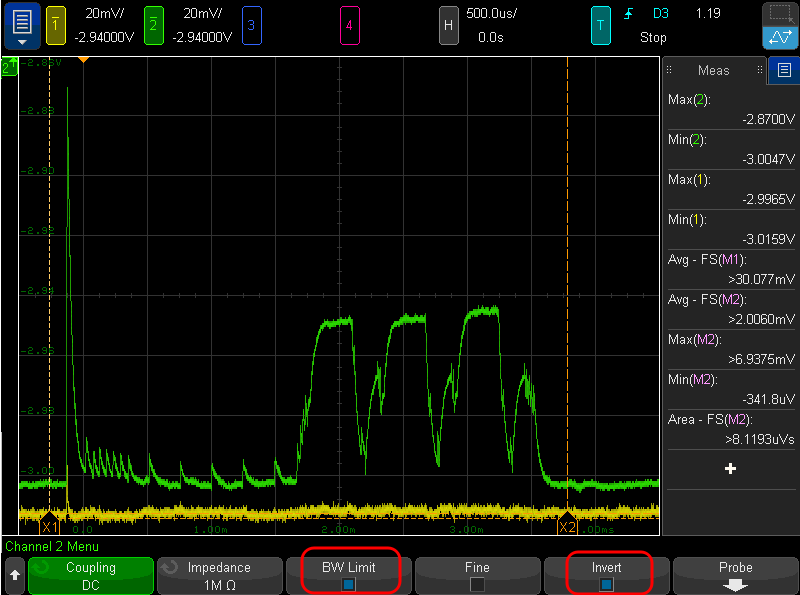
Bandwidth filtering: The analog inputs on the scope usually have a bandwidth filter. Turning this on will reduce the noise level. We do not need a high bandwidth to measure DC current.
Invert: Since we measure the voltage drop, it is convenient to invert the signal, since a negative voltage correspond to a positive current
Channel configuration
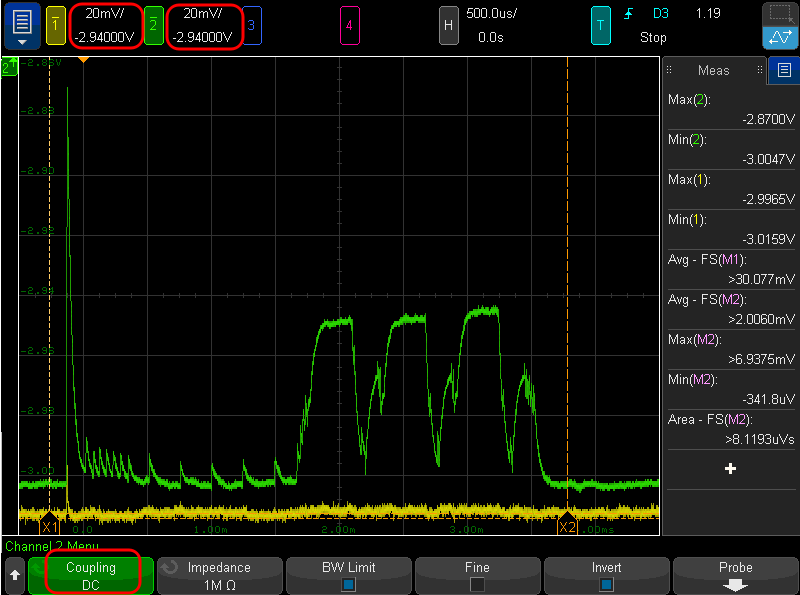
Offset: Adjust the offset on each channel so that the idle current, or lowest current is at the bottom of the screen (if you did not invert the signal, it should be at the top of the screen).
In this example we use VDD=3.0V, meaning that the offset should be close to -3.0V.
V/div: Change the voltage per div on each channel so that the signal fills the whole screen, but does not clip the signal. Same V/div on both probes.
AC coupling: Normally we would use DC coupling. However, on some scopes we can not have a large offset (3V in this case) and at the same time use a V/div small enough for detailed plots. An alternative is to use AC coupling instead of DC coupling on both channels and then set the offset to 0V.
Trigger
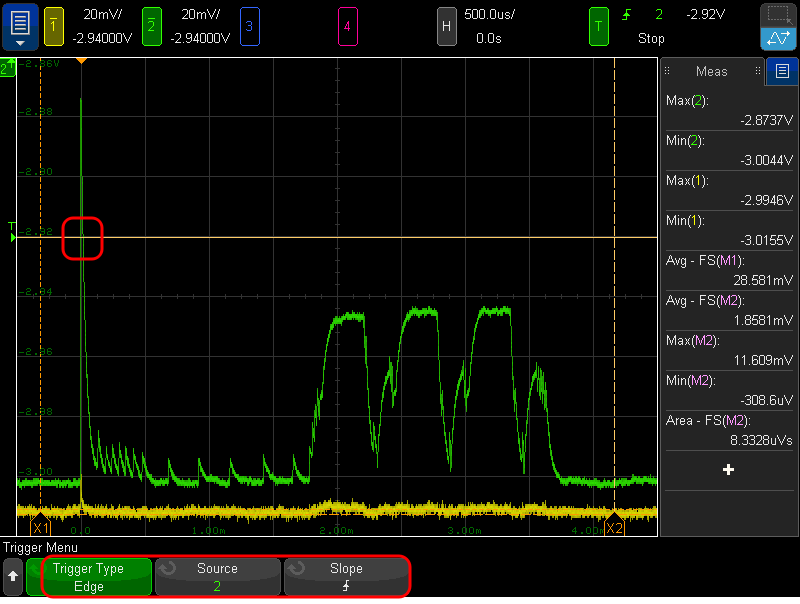
It is convenient to set the edge trigger to the the first spike in the event, on the channel that is on the DUT side of the shunt resistor, since it has the largest voltage drop. In this case CH2.
You will find this under the “Trigger” menu/button.
Oversampling
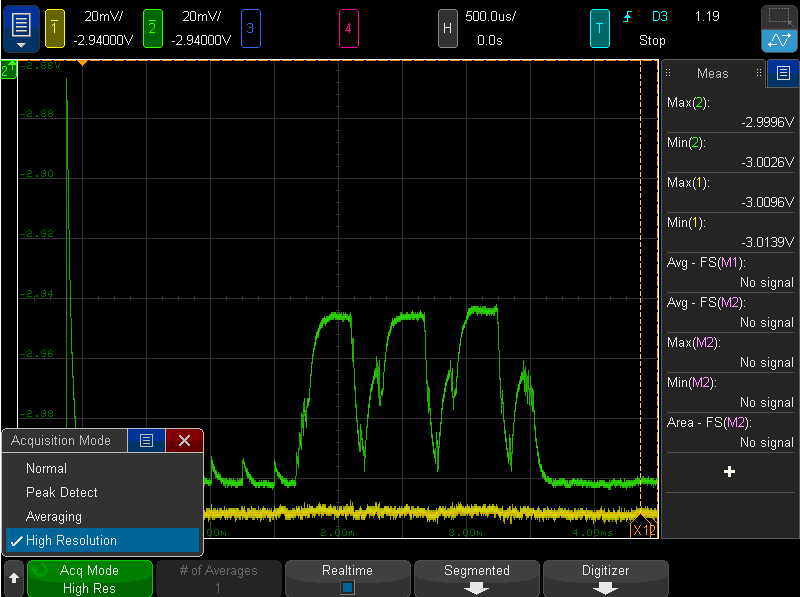
Most scopes have digital post processing of the signal to filter out noise. This is called different things. “High resolution”, “sin x interpolation”, etc.
You will find this under the “Acquire” menu/button.
Cursors
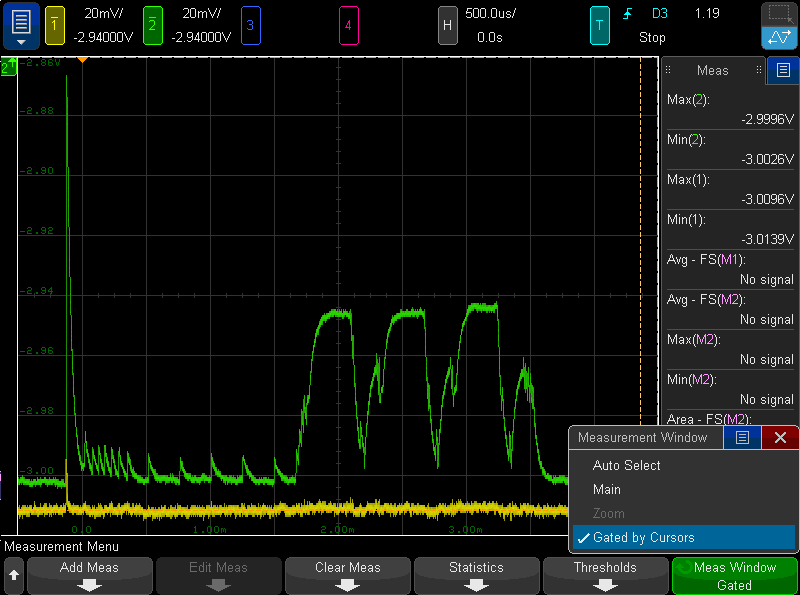
We can set our measurements in the right column to be gated by the cursors, meaning that we only measure what is between the cursors. The default is to measure the entire screen. This way we can use cursors to inspect the different parts of the plot
You will find this under the “Meas” menu/button.
Math 1
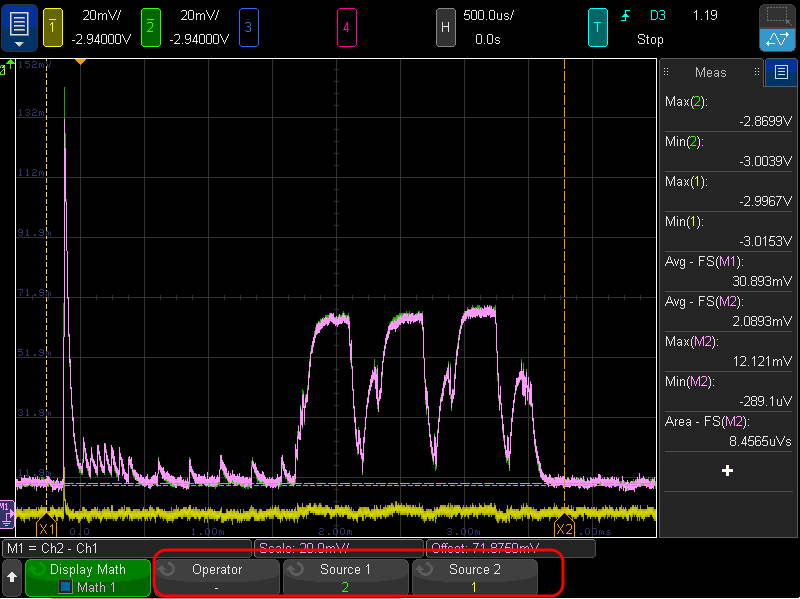
M1 = CH2 – CH1
Since we want to measure only the voltage drop over the shunt resistor, we need to use the math function on the scope to subtract the supply side voltage (CH1) from the DUT side voltage (CH2)
You will find this under the “Math” menu/button
Math 2
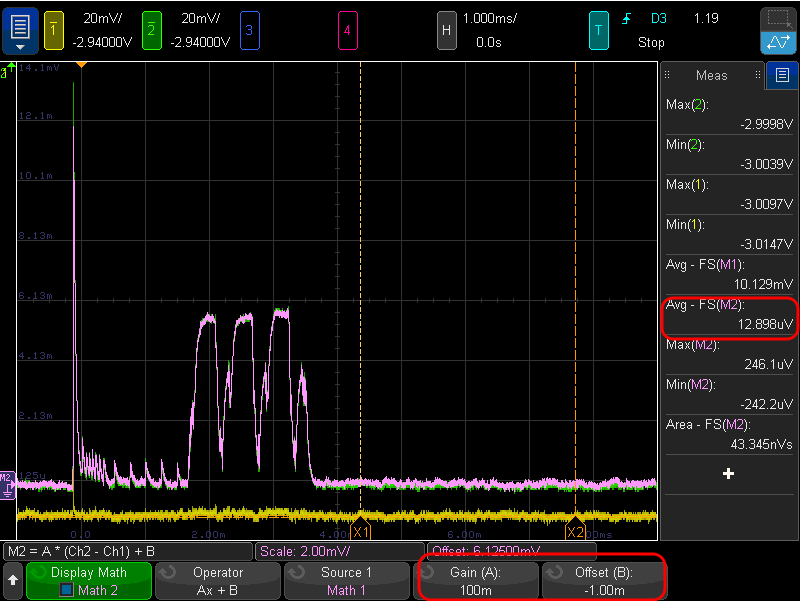
M2 = M1*A + B
It is convenient to add another math function that takes the output of the first math function and scales it according to the shunt value, and also fixes any offset issues.
This way we can read the current directly out from the scope measurements. (Measurements will still be displayed as Voltage, but we can just swap this out with Ampere)
We set the gain, A, to 0.1 since our shunt resistor is 10Ohm
And we also change the offset, B, so that the idle period in the plot gets close to 0. This is because that this method often adds quite a large offset, which we need to compensate for. We can not use this method to measure the idle current reliably, unless we use a much larger shunt resistor.
Measurements
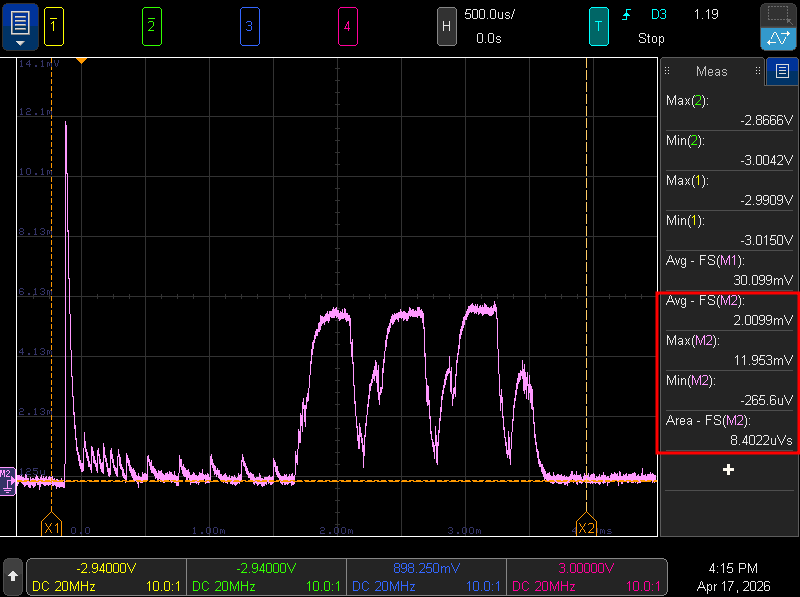
Now we are ready to add measurements to our plot. We want to add measurements for the Math 2 function (M2).
You will find this under the “Meas” menu/button.
In this plot we have added 4 measurements, avg, max, min and area. We can read the following information out from these measurements:
Avg – average current = 2.01 mA
Max – max current = 11.95 mA
Min – min current = -0.27 mA
Area – charge = 8.40 uC
Since our measurements are gated by the cursors, we can move these around and capture other things like TX run current, etc

Multimeter/amperemeter

While the oscilloscope is good for higher currents and detailed power profiling, an amperemeter is kind of the opposite, complementing each other. An amperemeter is often accurate enough for the lowest current, when fixed at the lowest measurement range, but it does not give you any information about the power profile. So you can use it for measuring idle current, verifying your setup, etc. And it will be much less error prone than using a complex instrument you have configured wrong. Can be used for sanity checking measurement setups.

You should keep in mind that if you measure a periodic signal, the period should be significantly shorter than the refresh interval of the display, otherwise it will miss the periodic signal and only show the idle current in between.

Note

Keeping the multimeter in series with the DUT, in the lowest current range (purpose is to measure idle current), The chip can fail to boot, because the multimeter will limit the current. So you fail to measure the idle current, but instead you measure the DUT in a reset loop. A solution is to set the multimeter to the highest range when turning on the power, then switching to the lowest range when measuring. If the device resets when switching to the lower range, because of a voltage glitch, you can keep it in the lowest range, but short the multimeter terminals when power is first applied, letting the device boot, before the short is removed, and current is measured.

Make sure to Log in or Register to save your progress

Back
Next

Nordic Developer Academy Privacy Policy


1. Introduction 

In this Privacy Policy you will find information on Nordic Semiconductor ASA (“Nordic Semiconductor”) processes your personal data when you use the Nordic Developer Academy.

References to “we” and “us” in this document refers to Nordic Semiconductor.


2. Our processing of personal data when you use the Nordic Developer Academy 

2.1 Nordic Developer Academy 

Nordic Semiconductor processes personal data in order to provide you with the features and functionality of the Nordic Developer Academy. Creating a user account is optional, but required if you want to track you progress and view your completed courses and obtained certificates. If you choose to create a user account, we will process the following categories of personal data:

  • Email
  • Name
  • Password (encrypted)
  • Course progression (e.g. which course you have completely or partly completed)
  • Certificate information, which consists of name of completed course and the validity of the certificate
  • Course results

During your use of the Nordic Developer Academy, you may also be asked if you want to provide feedback. If you choose to respond to any such surveys, we will also process the personal data in your responses in that survey.

The legal basis for this processing is GDPR article 6 (1) b. The processing is necessary for Nordic Semiconductor to provide the Nordic Developer Academy under the Terms of Service.


2.2 Analytics 

If you consent to analytics, Nordic Semiconductor will use Google Analytics to obtain statistics about how the Nordic Developer Academy is used. This includes collecting information on for example what pages are viewed, the duration of the visit, the way in which the pages are maneuvered, what links are clicked, technical information about your equipment. The information is used to learn how Nordic Developer Academy is used and how the user experience can be further developed.


2.2 Newsletter 

You can consent to receive newsletters from Nordic from within the Nordic Developer Academy. How your personal data is processed when you sign up for our newsletters is described in the Nordic Semiconductor Privacy Policy.


3. Retention period 

We will store your personal data for as long you use the Nordic Developer Academy. If our systems register that you have not used your account for 36 months, your account will be deleted.


4. Additional information 

Additional information on how we process personal data can be found in the Nordic Semiconductor Privacy Policy and Cookie Policy.

‍‍ 

Nordic Developer Academy Terms of Service


1. Introduction

‍These terms and conditions (“Terms of Use”) apply to the use of the Nordic Developer Academy, provided by Nordic Semiconductor ASA, org. nr. 966 011 726, a public limited liability company registered in Norway (“Nordic Semiconductor”). ‍

Nordic Developer Academy allows the user to take technical courses related to Nordic Semiconductor products, software and services, and obtain a certificate certifying completion of these courses. By completing the registration process for the Nordic Developer Academy, you are agreeing to be bound by these Terms of Use.

These Terms of Use are applicable as long as you have a user account giving you access to Nordic Developer Academy.‍

‍2. Access to and use of Nordic Developer Academy

‍‍Upon acceptance of these Terms of Use you are granted a non-exclusive right of access to, and use of Nordic Developer Academy, as it is provided to you at any time. Nordic Semiconductor provides Nordic Developer Academy to you free of charge, subject to the provisions of these Terms of Use and the Nordic Developer Academy Privacy Policy.

To access select features of Nordic Developer Academy, you need to create a user account. You are solely responsible for the security associated with your user account, including always keeping your login details safe.

You will able to receive an electronic certificate from Nordic Developer Academy upon completion of courses. By issuing you such a certificate, Nordic Semiconductor certifies that you have completed the applicable course, but does not provide any further warrants or endorsements for any particular skills or professional qualifications.

Nordic Semiconductor will continuously develop Nordic Developer Academy with new features and functionality, but reserves the right to remove or alter any existing functions without notice.

‍3. Acceptable use

You undertake that you will use Nordic Developer Academy in accordance with applicable law and regulations, and in accordance with these Terms of Use.‍ You must not modify, adapt, or hack Nordic Developer Academy or modify another website so as to falsely imply that it is associated with Nordic Developer Academy, Nordic Semiconductor, or any other Nordic Semiconductor product, software or service.

You agree not to reproduce, duplicate, copy, sell, resell or in any other way exploit any portion of Nordic Developer Academy, use of Nordic Developer Academy, or access to Nordic Developer Academy without the express written permission by Nordic Semiconductor. You must not upload, post, host, or transmit unsolicited email, SMS, or \”spam\” messages.

You are responsible for ensuring that the information you post and the content you share does not;

  • contain false, misleading or otherwise erroneous information
  • infringe someone else’s copyrights or other intellectual property rights
  • contain sensitive personal data or
  • contain information that might be received as offensive or insulting.
  • Such information may be removed without prior notice.

‍Nordic Semiconductor reserves the right to at any time determine whether a use of Nordic Developer Academy is in violation of its requirements for acceptable use.

Violation of the at any time applicable requirements for acceptable use may result in termination of your account. We will take reasonable steps to notify you and state the reason for termination in such cases.

‍4. Routines for planned maintenance

‍Certain types of maintenance may imply a stop or reduction in availability of Nordic Developer Academy. Nordic Semiconductor does not warrant any level of service availability but will provide its best effort to limit the impact of any planned maintenance on the availability of Nordic Developer Academy.

5. Intellectual property rights

‍Nordic Semiconductor retains all rights to all elements of Nordic Developer Academy. This includes, but is not limited to, the concept, design, trademarks, know-how, trade secrets, copyrights and all other intellectual property rights.

Nordic Semiconductor receives all rights to all content uploaded or created in Nordic Developer Academy. You do not receive any license or usage rights to Nordic Developer Academy beyond what is explicitly stated in this Agreement.

‍6. Liability and damages

‍Nothing within these Terms of Use is intended to limit your statutory data privacy rights as a data subject, as described in the Nordic Developer Academy Privacy Policy. ‍You acknowledge that errors might occur from time to time and waive any right to claim for compensation as a result of errors in Nordic Developer Academy. When an error occurs, you shall notify Nordic Semiconductor of the error and provide a description of the error situation.

You agree to indemnify Nordic Semiconductor for any loss, including indirect loss, arising out of or in connection with your use of Nordic Developer Academy or violations of these Terms of Use. ‍Nordic Semiconductor shall not be held liable for, and does not warrant that (i) Nordic Developer Academy will meet your specific requirements, (ii) Nordic Developer Academy will be uninterrupted, timely, secure, or error-free, (iii) the results that may be obtained from the use of Nordic Developer Academy will be accurate or reliable, (iv) the quality of any products, services, information, or other material purchased or obtained by you through Nordic Developer Academy will meet your expectations, or that (v) any errors in Nordic Developer Academy will be corrected.

You accept that this is a service provided to you without any payment and hence you accept that Nordic Semiconductor will not be held responsible, or liable, for any breaches of these Terms of Use or any loss connected to your use of Nordic Developer Academy. Unless otherwise follows from mandatory law, Nordic Semiconductor will not accept any such responsibility or liability.

‍7. Change of terms

‍Nordic Semiconductor may update and change the Terms of Use from time to time. Nordic Semiconductor will seek to notify you about significant changes before such changes come into force and give you a possibility to evaluate the effects of proposed changes. Continued use of Nordic Developer Academy after any such changes shall constitute your acceptance of such changes. You can review the current version of the Terms of Use at any time at https://academy.nordicsemi.com/terms-of-service/

‍8. Transfer of rights

‍Nordic Semiconductor is entitled to transfer its rights and obligation pursuant to these Terms of Use to a third party as part of a merger or acquisition process, or as a result of other organizational changes.

‍9. Third Party Services

‍‍To the extent Nordic Developer Academy facilitates access to services provided by a third party, you agree to comply with the terms governing such third party services. Nordic Semiconductor shall not be held liable for any errors, omissions, inaccuracies, etc. related to such third party services.

‍10. Dispute resolution

‍‍The Terms of Use and any other legally binding agreement between yourself and Nordic Semiconductor shall be subject to Norwegian law and Norwegian courts’ exclusive jurisdiction.

 

Switch language?

Progress is tracked separately for each language. Switching will continue from your progress in that language or start fresh if you haven't begun.

Your current progress is saved, and you can switch back anytime.

Log in
Don’t have an account? Register an account

Forgot your password?
Register an account
Already have an account? Log in
(All fields are required unless specified optional)

  • 8 or more characters
  • Upper and lower case letters
  • At least one number or special character

Forgot your password?
Enter the email associated with your account, and we will send you a link to reset your password.

Back to Log in

Insert/edit link

Enter the destination URL

Or link to existing content

    No search term specified. Showing recent items. Search or use up and down arrow keys to select an item.

      Change summary

      What's new in the latest version

      General updates

      General updates

      •Support for nRF54LS05 DK (Available through the early access sampling program)
      •Support for the nRF54LM20B with Axon NPU for Edge AI applications
      Bluetooth LE updates

      Bluetooth LE updates

      •Quality of Service module is now production-ready.
      •New experimental features for RF testing (Direct Test Mode) and low-latency packet handling (LE Flushable ACL).
      MCUboot & Partition Manager

      MCUboot & Partition Manager

      •Single-Slot DFU and RAM Load mode are both promoted to fully supported
      •Partition Manager is officially deprecated in favor of Zephyr's devicetree-based partitioning.