In this topic, we will look at how to use the nRF Cloud dashboard to analyze data from deployed Bluetooth LE devices. We will cover how to navigate the dashboard, interpret per-device metric timelines, identify fleet-wide trends, and use crash data to debug firmware faults remotely.
The goal is to connect the data points from Topic 2 and the integration from Topic 3 to practical debugging workflows. By the end of this topic, you should have a better understanding of how to interpret a device’s metric timeline and relate it to the power budget expectations from earlier lessons.
Per-device metric timelines
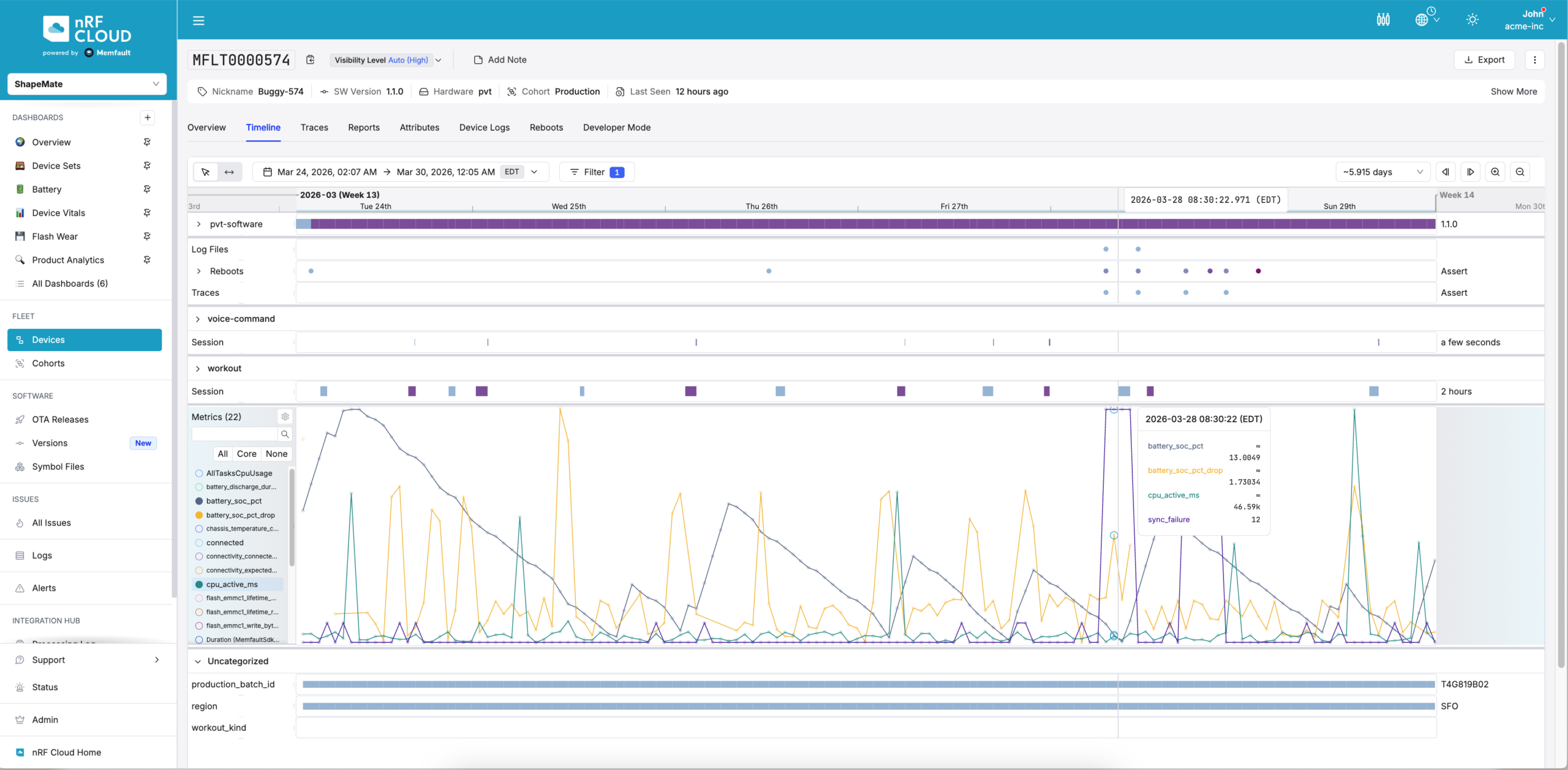
When you select a device in the nRF Cloud dashboard, you can view its metric timeline. This is a chronological view of all heartbeat data reported by the device. Each heartbeat appears as a data point on the timeline, and you can select individual heartbeats to inspect the full set of metric values at that point in time.
Device timeline in nRF Cloud
For a Bluetooth LE peripheral with the Memfault SDK configured as described in Topic 3, each heartbeat will include the automatically collected metrics: connection interval, peripheral latency, supervision timeout, PHY, data length, RSSI, peer vendor and version, disconnect count, connection event count, and connected time.
The timeline view is useful for tracking how a device’s behavior changes over time. For example, you might observe that a device starts with a 1000 ms connection interval as expected, but after a firmware update on the user’s phone, the interval drops to 30 ms because the updated phone app requests different connection parameters. The metric timeline makes this change visible, along with the relative time it occurred.
You can also overlay multiple metrics on the same timeline. Plotting connection interval alongside battery state of charge lets you visually correlate shorter connection intervals with faster battery drain. Plotting RSSI alongside disconnect count lets you see whether disconnections correspond to periods of weak signal.
Reboot and crash tracking
Every time a device reboots, the Memfault SDK captures the reset reason and reports it in the next heartbeat. The nRF Cloud dashboard displays reboot events on the device timeline, making it easy to see when and how often a device is resetting.
Reboots are categorized by cause, such as pin reset, power-on reset, watchdog timeout, hard fault, and application assert. This categorization helps you quickly distinguish between expected reboots (such as a user-initiated reset or a firmware update) and unexpected ones (such as a hard fault or watchdog timeout).
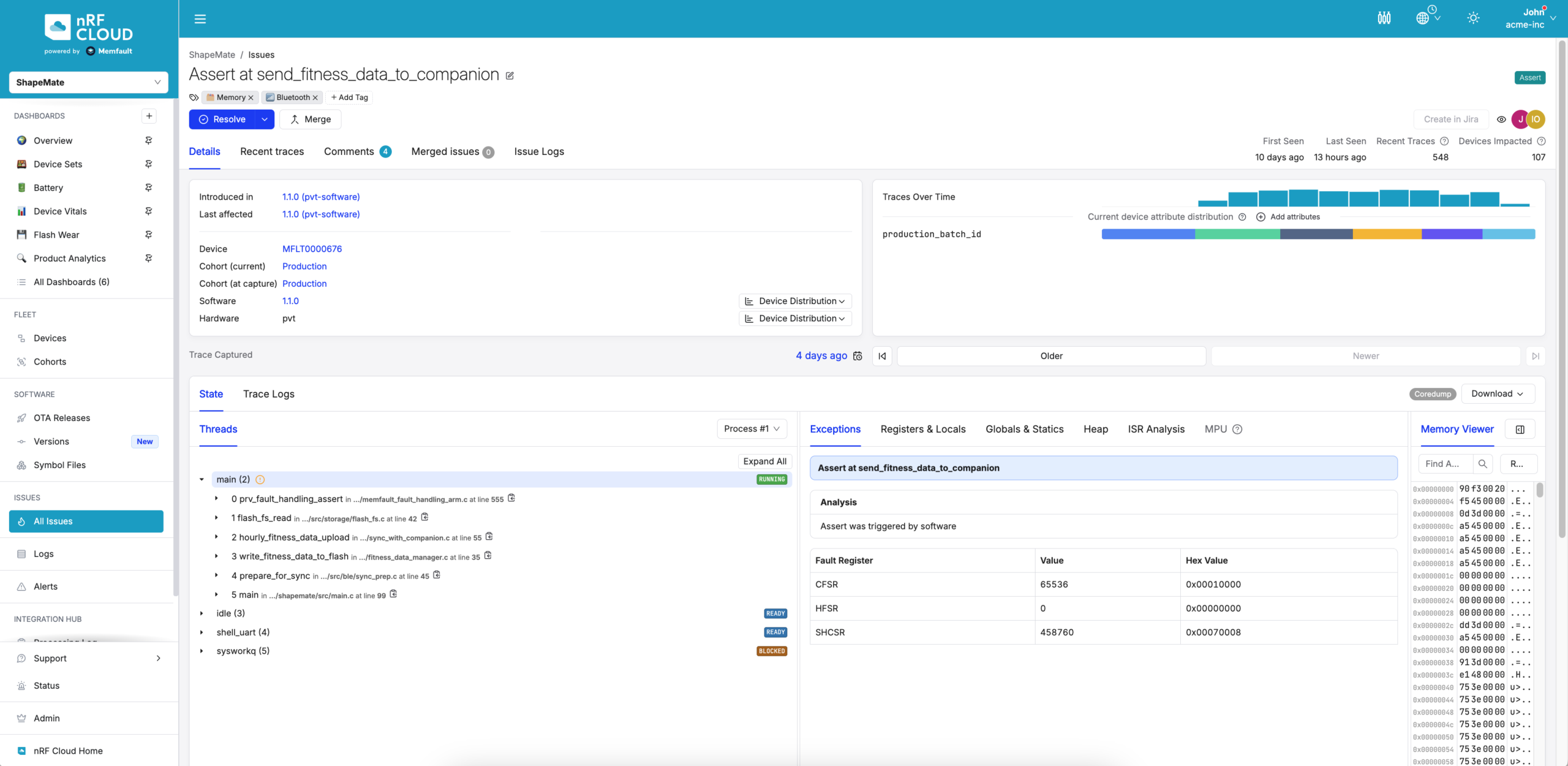
When a crash occurs, the Memfault SDK captures a coredump containing the CPU register state, active thread stacks, and key memory regions. This coredump is stored on the device and transmitted to the cloud the next time a central connects. In the nRF Cloud dashboard, you can inspect the coredump to see the full backtrace at the time of the fault, including the function name, source file, and line number for each frame in the call stack.
Coredump view in nRF Cloud
This is particularly valuable for Bluetooth LE devices where crashes may be difficult to reproduce. A fault that only occurs after a specific sequence of GATT operations, or only when connected to a particular phone model, may never appear in lab testing. With remote coredump capture, you get the same level of debug information you would have with a debugger attached, but from a device in the field.
Correlating crashes with Bluetooth LE activity
When you see a crash on the device timeline, you can look at the surrounding heartbeats to understand what was happening at the time of the fault.
For example, suppose you see an assert in a GATT notification send function. By looking at the heartbeat data around the crash, you might find that the device had just experienced a data length update, or that the peer vendor was a specific manufacturer. This context narrows the investigation significantly compared to a standalone crash report with no surrounding data.
Similarly, if a device shows a watchdog timeout, the surrounding metrics might reveal that the connection event count was unusually high, suggesting the CPU was spending too much time servicing Bluetooth LE events and starving other threads. Or the metrics might show that RSSI was very low, indicating the device was struggling with retransmissions in a noisy RF environment.
Fleet-wide metric charts
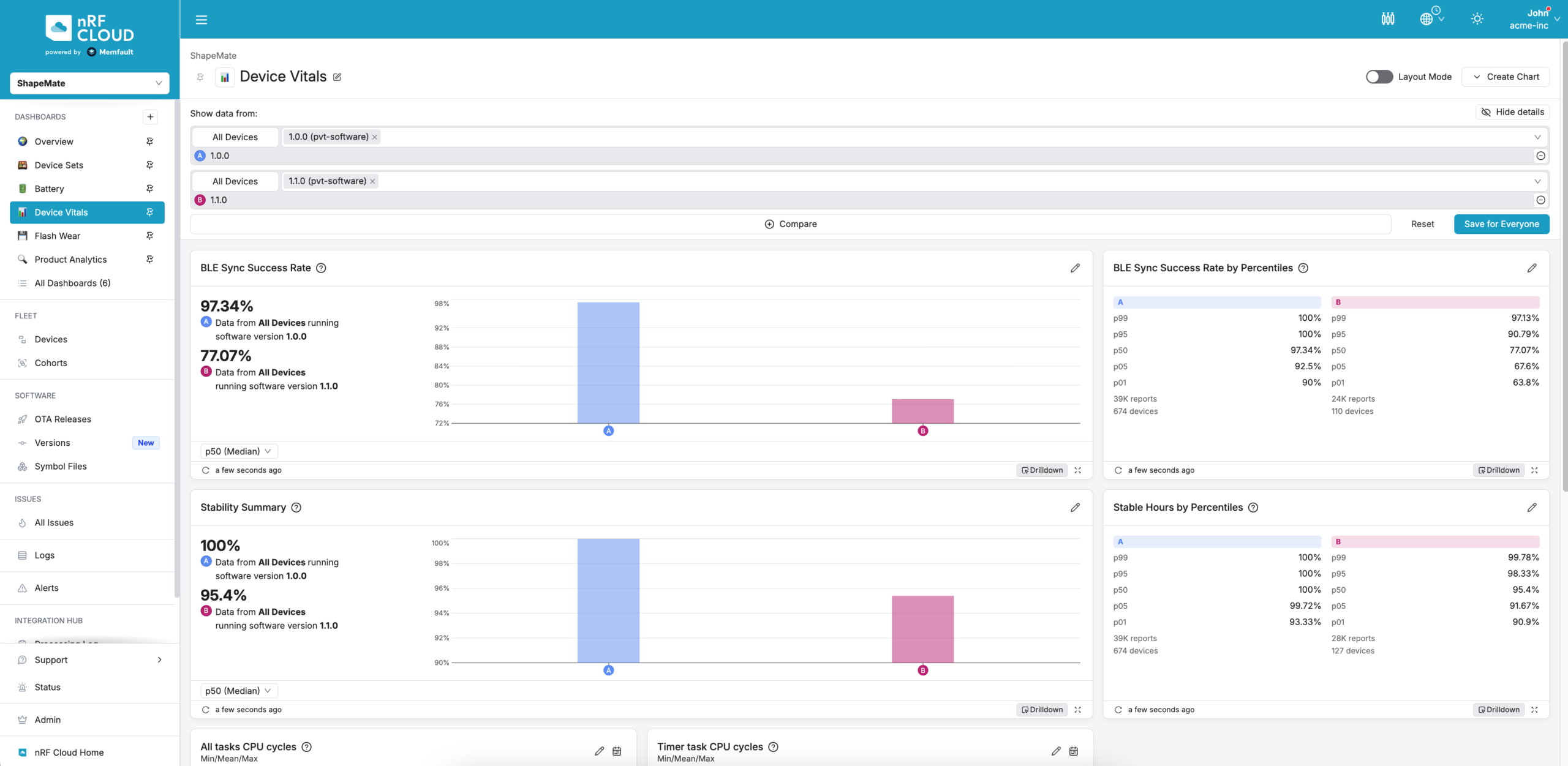
Beyond individual device analysis, the nRF Cloud dashboard provides fleet-wide views that aggregate metrics across all devices or across devices running a specific firmware version. This is where you can identify systemic issues that affect a subset of your fleet.
A common workflow is to compare a key metric across firmware versions. For example, you might track the Bluetooth LE sync success rate (the ratio of successful connection synchronizations to total attempts) across three firmware releases. If version 1.1.0 shows a significantly lower sync success rate than version 1.0.0, you know that a regression was introduced in that release. You can then drill down into the devices running version 1.1.0 to look at their individual metric timelines and crash data to find the root cause.
Fleet-wide views are also useful for understanding the distribution of peer devices your product connects to in practice. If 80% of your fleet connects to Apple devices and 15% connects to Samsung devices, you know where to focus your interoperability testing. If disconnection rates are disproportionately high for a specific peer vendor, you have a clear signal to investigate compatibility with that vendor’s Bluetooth stack.
Debugging workflow example
To tie these concepts together, here is a typical debugging workflow using the nRF Cloud dashboard.
A customer reports that their device’s battery is draining faster than expected. You look up the device by its serial number in the dashboard. On the device timeline, you see that battery state of charge is dropping roughly twice as fast as your power budget predicted.
You overlay the connection interval metric and notice that the device is running at a 15 ms connection interval instead of the 1000 ms interval your firmware requests. Looking at the peer information, you see the device is connected to an older Android phone running Bluetooth link layer version 4.2.
You check the connection parameter update metrics and find that the data length is at the default 27 bytes, confirming that DLE negotiation did not succeed with this peer. The combination of a short connection interval and no DLE explains the higher-than-expected power consumption.
With this information, you can update your firmware to handle the case where the central rejects the parameter update request. For example, you might implement a retry strategy, adjust the advertising interval to reconnect less aggressively if parameters cannot be updated, or accept the shorter interval but increase peripheral latency to compensate.
How remote observability complements other tooling
Remote observability is a complement to the bench-level tools and techniques covered in earlier lessons, not a replacement. The PPK2 and oscilloscope give you detailed, high-resolution current profiles that are essential for understanding exactly what happens during a single advertising event or connection interval. The nRF Cloud dashboard gives you a higher-level view over hours, days, and weeks across many devices.
The best approach is to use bench tools during development to optimize and validate your power budget under controlled conditions, and then use remote observability to verify that those optimizations hold up across the diversity of real-world conditions your product will encounter.
Nordic Developer Academy Privacy Policy
1. Introduction
In this Privacy Policy you will find information on Nordic Semiconductor ASA (“Nordic Semiconductor”) processes your personal data when you use the Nordic Developer Academy.
References to “we” and “us” in this document refers to Nordic Semiconductor.
2. Our processing of personal data when you use the Nordic Developer Academy
2.1 Nordic Developer Academy
Nordic Semiconductor processes personal data in order to provide you with the features and functionality of the Nordic Developer Academy. Creating a user account is optional, but required if you want to track you progress and view your completed courses and obtained certificates. If you choose to create a user account, we will process the following categories of personal data:
Email
Name
Password (encrypted)
Course progression (e.g. which course you have completely or partly completed)
Certificate information, which consists of name of completed course and the validity of the certificate
Course results
During your use of the Nordic Developer Academy, you may also be asked if you want to provide feedback. If you choose to respond to any such surveys, we will also process the personal data in your responses in that survey.
The legal basis for this processing is GDPR article 6 (1) b. The processing is necessary for Nordic Semiconductor to provide the Nordic Developer Academy under the Terms of Service.
2.2 Analytics
If you consent to analytics, Nordic Semiconductor will use Google Analytics to obtain statistics about how the Nordic Developer Academy is used. This includes collecting information on for example what pages are viewed, the duration of the visit, the way in which the pages are maneuvered, what links are clicked, technical information about your equipment. The information is used to learn how Nordic Developer Academy is used and how the user experience can be further developed.
2.2 Newsletter
You can consent to receive newsletters from Nordic from within the Nordic Developer Academy. How your personal data is processed when you sign up for our newsletters is described in the Nordic Semiconductor Privacy Policy.
3. Retention period
We will store your personal data for as long you use the Nordic Developer Academy. If our systems register that you have not used your account for 36 months, your account will be deleted.
4. Additional information
Additional information on how we process personal data can be found in the Nordic Semiconductor Privacy Policy and Cookie Policy.
Nordic Developer Academy Terms of Service
1. Introduction
These terms and conditions (“Terms of Use”) apply to the use of the Nordic Developer Academy, provided by Nordic Semiconductor ASA, org. nr. 966 011 726, a public limited liability company registered in Norway (“Nordic Semiconductor”).
Nordic Developer Academy allows the user to take technical courses related to Nordic Semiconductor products, software and services, and obtain a certificate certifying completion of these courses. By completing the registration process for the Nordic Developer Academy, you are agreeing to be bound by these Terms of Use.
These Terms of Use are applicable as long as you have a user account giving you access to Nordic Developer Academy.
2. Access to and use of Nordic Developer Academy
Upon acceptance of these Terms of Use you are granted a non-exclusive right of access to, and use of Nordic Developer Academy, as it is provided to you at any time. Nordic Semiconductor provides Nordic Developer Academy to you free of charge, subject to the provisions of these Terms of Use and the Nordic Developer Academy Privacy Policy.
To access select features of Nordic Developer Academy, you need to create a user account. You are solely responsible for the security associated with your user account, including always keeping your login details safe.
You will able to receive an electronic certificate from Nordic Developer Academy upon completion of courses. By issuing you such a certificate, Nordic Semiconductor certifies that you have completed the applicable course, but does not provide any further warrants or endorsements for any particular skills or professional qualifications.
Nordic Semiconductor will continuously develop Nordic Developer Academy with new features and functionality, but reserves the right to remove or alter any existing functions without notice.
3. Acceptable use
You undertake that you will use Nordic Developer Academy in accordance with applicable law and regulations, and in accordance with these Terms of Use. You must not modify, adapt, or hack Nordic Developer Academy or modify another website so as to falsely imply that it is associated with Nordic Developer Academy, Nordic Semiconductor, or any other Nordic Semiconductor product, software or service.
You agree not to reproduce, duplicate, copy, sell, resell or in any other way exploit any portion of Nordic Developer Academy, use of Nordic Developer Academy, or access to Nordic Developer Academy without the express written permission by Nordic Semiconductor. You must not upload, post, host, or transmit unsolicited email, SMS, or \”spam\” messages.
You are responsible for ensuring that the information you post and the content you share does not;
contain false, misleading or otherwise erroneous information
infringe someone else’s copyrights or other intellectual property rights
contain sensitive personal data or
contain information that might be received as offensive or insulting.
Such information may be removed without prior notice.
Nordic Semiconductor reserves the right to at any time determine whether a use of Nordic Developer Academy is in violation of its requirements for acceptable use.
Violation of the at any time applicable requirements for acceptable use may result in termination of your account. We will take reasonable steps to notify you and state the reason for termination in such cases.
4. Routines for planned maintenance
Certain types of maintenance may imply a stop or reduction in availability of Nordic Developer Academy. Nordic Semiconductor does not warrant any level of service availability but will provide its best effort to limit the impact of any planned maintenance on the availability of Nordic Developer Academy.
5. Intellectual property rights
Nordic Semiconductor retains all rights to all elements of Nordic Developer Academy. This includes, but is not limited to, the concept, design, trademarks, know-how, trade secrets, copyrights and all other intellectual property rights.
Nordic Semiconductor receives all rights to all content uploaded or created in Nordic Developer Academy. You do not receive any license or usage rights to Nordic Developer Academy beyond what is explicitly stated in this Agreement.
6. Liability and damages
Nothing within these Terms of Use is intended to limit your statutory data privacy rights as a data subject, as described in the Nordic Developer Academy Privacy Policy. You acknowledge that errors might occur from time to time and waive any right to claim for compensation as a result of errors in Nordic Developer Academy. When an error occurs, you shall notify Nordic Semiconductor of the error and provide a description of the error situation.
You agree to indemnify Nordic Semiconductor for any loss, including indirect loss, arising out of or in connection with your use of Nordic Developer Academy or violations of these Terms of Use. Nordic Semiconductor shall not be held liable for, and does not warrant that (i) Nordic Developer Academy will meet your specific requirements, (ii) Nordic Developer Academy will be uninterrupted, timely, secure, or error-free, (iii) the results that may be obtained from the use of Nordic Developer Academy will be accurate or reliable, (iv) the quality of any products, services, information, or other material purchased or obtained by you through Nordic Developer Academy will meet your expectations, or that (v) any errors in Nordic Developer Academy will be corrected.
You accept that this is a service provided to you without any payment and hence you accept that Nordic Semiconductor will not be held responsible, or liable, for any breaches of these Terms of Use or any loss connected to your use of Nordic Developer Academy. Unless otherwise follows from mandatory law, Nordic Semiconductor will not accept any such responsibility or liability.
7. Change of terms
Nordic Semiconductor may update and change the Terms of Use from time to time. Nordic Semiconductor will seek to notify you about significant changes before such changes come into force and give you a possibility to evaluate the effects of proposed changes. Continued use of Nordic Developer Academy after any such changes shall constitute your acceptance of such changes. You can review the current version of the Terms of Use at any time at https://academy.nordicsemi.com/terms-of-service/
8. Transfer of rights
Nordic Semiconductor is entitled to transfer its rights and obligation pursuant to these Terms of Use to a third party as part of a merger or acquisition process, or as a result of other organizational changes.
9. Third Party Services
To the extent Nordic Developer Academy facilitates access to services provided by a third party, you agree to comply with the terms governing such third party services. Nordic Semiconductor shall not be held liable for any errors, omissions, inaccuracies, etc. related to such third party services.
10. Dispute resolution
The Terms of Use and any other legally binding agreement between yourself and Nordic Semiconductor shall be subject to Norwegian law and Norwegian courts’ exclusive jurisdiction.
Switch language?
Progress is tracked separately for each language. Switching will continue from your progress in that language or start fresh if you haven't begun.
Your current progress is saved, and you can switch back anytime.
•This patch release is part of the v3.4 release branch, which has long-term support (LTS) for a period of five years.
•During this period, patch releases will provide updates for security vulnerabilities and critical bug fixes.
•API stability is guaranteed; breaking changes are only introduced when required by a security fix.
•Added the release.yaml file with device classification support overview
Device support
•Experimental support for the nRF54LC10A SoC.
MCUboot
•The build system no longer requires dedicated slots for the network core update candidate(nRF5340 SoC Only) •Support for compiling multiple image verification keys into MCUboot
General updates for nRF Connect SDK v3.4.0
•This release includes Long-Term Support (LTS) for five years.
•Patch (minor) releases will address security vulnerabilities and critical bug fixes.
•API stability is guaranteed; breaking changes are only introduced when required by a security fix.
•Notifications for critical bug fixes and security updates via the myNordic notification system (mynordic.nordicsemi.com)
General updates
•Support for nRF54LS05 DK (Available through the early access sampling program) •Support for the nRF54LM20B with Axon NPU for Edge AI applications
Bluetooth LE updates
•Quality of Service module is now production-ready. •New experimental features for RF testing (Direct Test Mode) and low-latency packet handling (LE Flushable ACL).
MCUboot & Partition Manager
•Single-Slot DFU and RAM Load mode are both promoted to fully supported •Partition Manager is officially deprecated in favor of Zephyr's devicetree-based partitioning.